



Human Resources
—
8
min read


Give your people a voice with a tailored Xref Engage survey.
Increase retention and reduce turnover with quick employee feedback from an Xref Pulse Survey.
Most hiring managers can tell you what a role costs to fill. Far fewer can tell you the cost of a bad hire. Advertising spend, agency fees, the hours spent interviewing. These are visible costs that show up somewhere in a budget. What rarely gets calculated is what happens when that hire doesn't work out.
A bad hire isn't just a recruitment problem. It's a financial one, an operational one, and in many cases a cultural one. The costs compound quickly, and most of them are invisible in the moment they're being incurred.
This post gives HR managers and P&C leaders a practical framework for calculating the true cost of a bad hire in their own organisation and for building the business case for the verification steps that prevent it.
The most common way organisations estimate bad hire cost is to multiply the departing employee's salary by a factor between 1.5 and 5. That range reflects genuine variation depending on seniority, role complexity, and how long the person stayed. But even the upper end of that estimate typically undercounts the real cost, because it focuses almost entirely on direct and visible expenditure.
The actual cost of a bad hire has two distinct components: the direct costs you can quantify immediately, and the indirect costs that accumulate over time and are harder to attribute to a single decision.
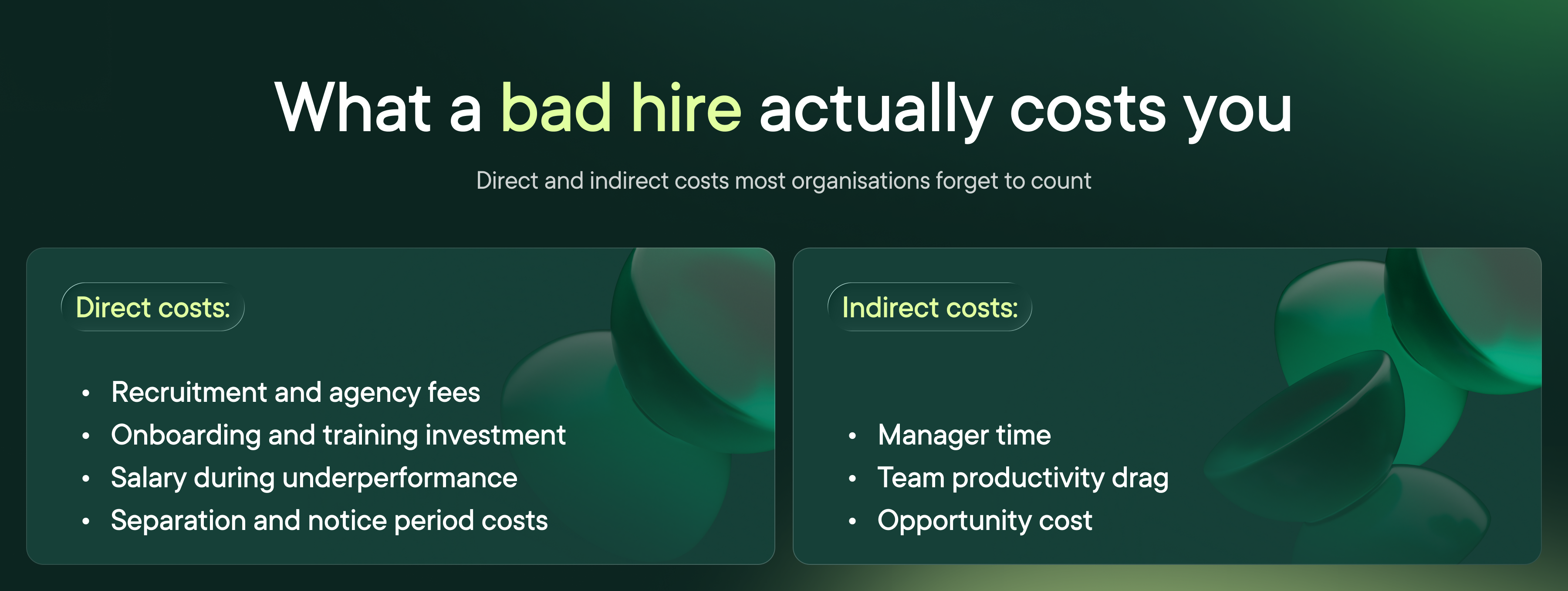
Recruitment costs
Onboarding and training investment
Salary paid during underperformance
Separation costs
These are the costs that rarely appear in a bad hire calculation, but are often the most significant in practice.
Manager time and attention
Team productivity and morale
Opportunity cost
The true cost of a bad hire is not what you paid for the person who did not work out. It is what you paid for that person, plus what you paid to replace them, plus everything that did not happen while the seat was occupied by the wrong hire.
The following framework uses conservative assumptions. In practice, most organisations find that the actual figure is higher once indirect costs are included.
Start with the direct costs: recruitment spend for the original hire, plus onboarding investment, plus salary paid during the underperformance period, plus separation costs, plus recruitment spend for the replacement hire. For a $90,000 role with a six-month underperformance period, direct costs alone typically reach $60,000 to $90,000.
Add the indirect costs: (manager hours spent on performance management x manager hourly rate) + (estimated team productivity impact, expressed as a percentage of team output over the affected period) + (opportunity cost, if quantifiable from a specific stalled project or client impact).
A conservative total for a single mid-level bad hire in a professional role is typically between $80,000 and $150,000. For senior roles, the figure can exceed $300,000 once all components are included.
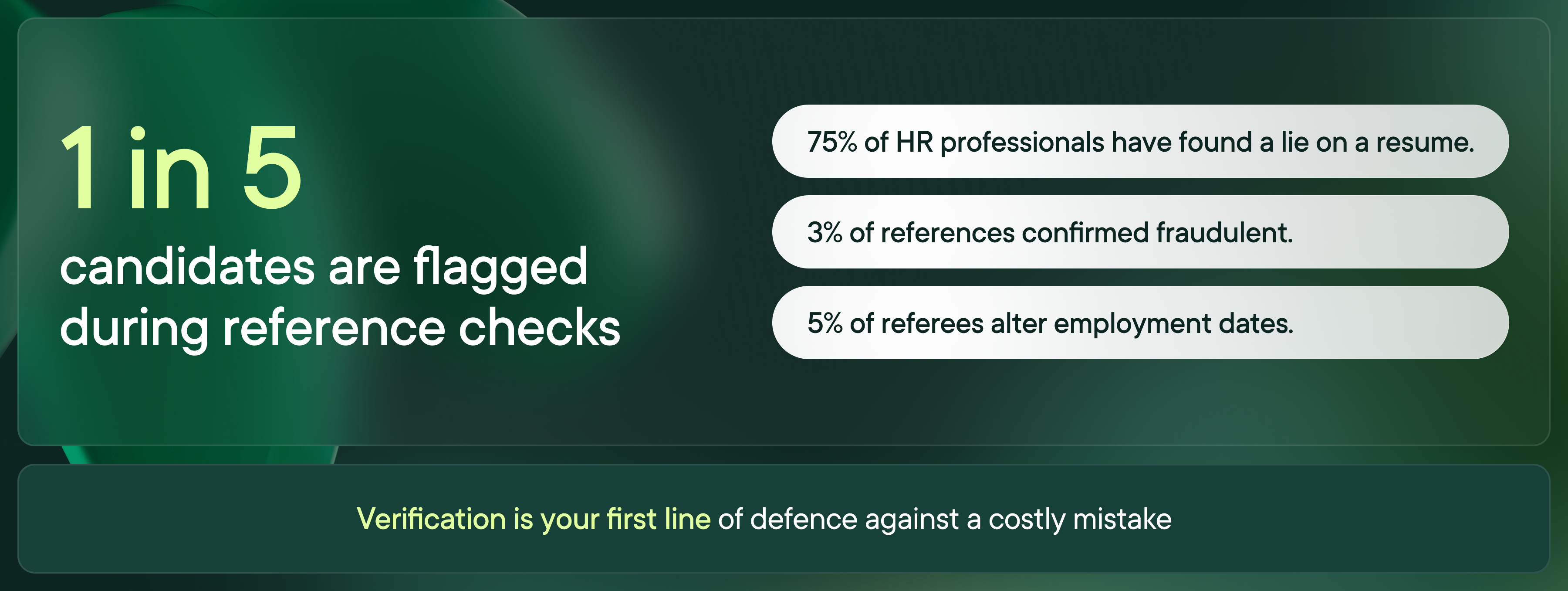
Bad hires are not random. They cluster around predictable failure points: overstated experience that doesn't hold up in practice, conduct or culture issues that were known to a previous employer, and employment history discrepancies that weren't caught before an offer was made.
Xref's data across 7 million+ references confirms this. 75% of HR professionals have found a lie on a resume. 1 in 5 candidates is flagged during reference checks. 3% of references are confirmed fraudulent. 3% of referees correct job titles. Another 5% alter employment dates.
These aren't edge cases. They are recurring patterns in the reference data that, when caught before a hiring decision, prevent the majority of the bad hire costs outlined above.

Automated reference checking with Xref costs a fraction of what a bad hire could. The average reference is returned within 18 to 24 hours. The process surfaces the patterns and discrepancies that manual phone referencing regularly misses.
Set that cost against the conservative estimate of $80,000 to $150,000 for a bad hire, and the return on investment is not difficult to calculate. Pre-hire verification is not a compliance cost. It is a risk management investment with a measurable, documentable return.
The organisations that calculate their bad hire cost once tend to change how they approach verification permanently. The number is usually larger than expected, and the prevention cost is usually smaller.
Start reducing your bad hire risk today. Try Xref and see how automated reference checking fits into your hiring process.
Uncover data-driven, actionable insights with automated reference, pulse and exit surveys.