



Human Resources
—
8
min read


Give your people a voice with a tailored Xref Engage survey.
Increase retention and reduce turnover with quick employee feedback from an Xref Pulse Survey.
Ask any hiring manager why they passed on a candidate and "culture fit" will come up more often than any specific skill gap. Ask them how they assessed it, and the answer is almost always some version of gut instinct.
That's a problem.
Culture fit is cited as a key driver in hiring decisions and a leading cause of early attrition when it's got wrong. Yet most organisations have no structured method for evaluating it before an offer is made. The result is a decision that carries enormous weight but almost no evidentiary basis.
The good news is that the information exists. You just have to ask the right people the right questions.
Interviews are the primary tool most organisations use to assess culture fit. They're also the least reliable format for doing it.
Candidates are coached, prepared, and highly motivated to present themselves as adaptable, collaborative, and aligned with your values. They know what you want to hear. And in a structured interview setting, most people can perform those qualities convincingly for 45 minutes.
What interviews cannot easily reveal is behaviour under pressure, conflict resolution style, how someone responds to feedback, or how they actually show up when things go wrong. These are the things that determine whether someone will genuinely fit into a team, not the polished answers they've rehearsed.
That's precisely where reference checks earn their keep.
A referee who has worked directly with a candidate for 12 months or more has observed something no interview can replicate: sustained, real-world behaviour across a range of situations.
They've seen how the person handles a difficult stakeholder. They know whether the candidate speaks up in meetings or defers to avoid conflict. They can tell you whether the person picks up the slack when a team is stretched, or whether they wait to be asked.
Xref data shows that 1 in 5 candidates are flagged during the reference checking process, not always for dishonesty, but for gaps between how they present and how they actually perform. Culture-related signals are a significant part of that picture.
A referee has no reason to volunteer this information unprompted. But when asked structured, specific questions, they will often give you an honest and nuanced picture of how a candidate operates in practice.
Before you write a single reference question, it helps to be clear about which behaviours you're actually trying to assess. Culture fit is not a monolithic quality. It breaks down into observable dimensions.
Collaboration and team dynamics: Does this person contribute ideas in group settings or hold back? How do they behave when they disagree with a colleague? Do they share credit or take it?
Response to feedback: Do they seek it out or avoid it? When they receive constructive feedback, do they act on it or defend themselves?
Conflict style: Do they address tension directly or let it simmer? Do they escalate or resolve?
Adaptability: How do they respond when priorities shift or plans fall apart? Do they stabilise the team or add to the noise?
Values alignment: Do they make decisions in the way your organisation would want them to? Do they hold themselves accountable when things go wrong?
Each of these can be probed through well-constructed reference questions.
The best culture fit reference check questions are behavioural and specific. They ask referees to describe what they observed, not to offer general impressions.
On team collaboration:
On feedback and growth:
On conflict and pressure:
On values and accountability:
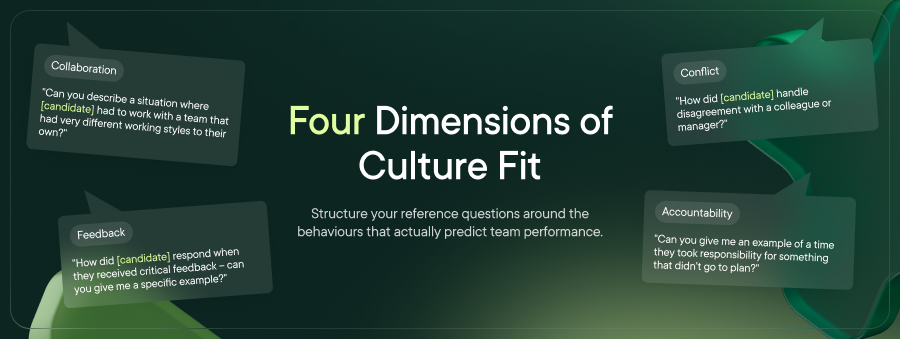
These questions work best in a structured format where every candidate's referees receive the same questions. That makes it possible to compare responses and identify patterns rather than relying on a single anecdote.
Referee responses won't always arrive with a clear verdict. Reading between the lines is part of the skill.
Watch for hedged language. Phrases like "in the right environment" or "once she settled in" often signal that the candidate's performance was context-dependent. Probe further.
Watch for what's absent. If a referee speaks warmly about a candidate's technical skills but says nothing about how they worked with others, that silence may be informative.
Watch for inconsistency. If one referee describes a candidate as a natural collaborator and another describes them as someone who preferred to work alone, you have a pattern worth exploring -- not necessarily disqualifying, but worth a follow-up conversation with the candidate.
Pay attention to energy shifts. When referees are asked about a candidate's response to feedback or conflict and they pause, qualify, or become noticeably more careful, that's a signal.
Structured digital reference checking helps here because responses are collected in writing, consistently worded, and comparable across referees. You're less likely to miss a signal when you're reading rather than listening.
One of the less-discussed benefits of structured culture fit reference check questions is that they can actually make culture-based decisions more defensible and less biased.
When culture fit is assessed informally, through impressions formed during interviews, corridor conversations, or a hiring manager's instinct, it becomes a vector for unconscious bias. Research consistently shows that informal culture assessments tend to favour candidates who are most similar to the existing team, which works against diversity.
Structured reference questions flip that. Instead of asking "does this person feel like one of us?", you're asking "does this person demonstrate the specific behaviours our team needs to function well?" Those are very different questions with very different implications.
When every candidate's referees answer the same questions in the same format, the data becomes comparable. You can identify trends, apply consistent standards, and make decisions based on observed behaviour rather than vibe.
A genuine concern with culture fit as a hiring criterion is when it becomes a proxy for homogeneity. Organisations that hire purely on "fit" can end up with teams that are less diverse, less innovative, and more susceptible to groupthink.
The antidote is specificity. "Culture fit" should never mean "someone who reminds me of the rest of the team." It should mean "someone whose working behaviours are compatible with how this team operates and aligned with what the organisation values."
That distinction matters legally as well. If a culture fit decision is ever challenged, you need to be able to point to documented behavioural evidence, not impressions. Structured reference data gives you exactly that.
It is also worth noting that culture contribution, what a candidate brings that the team currently lacks, is at least as valuable as culture fit. The best teams are not echo chambers. They are built from people who share values but bring different strengths, perspectives, and styles.
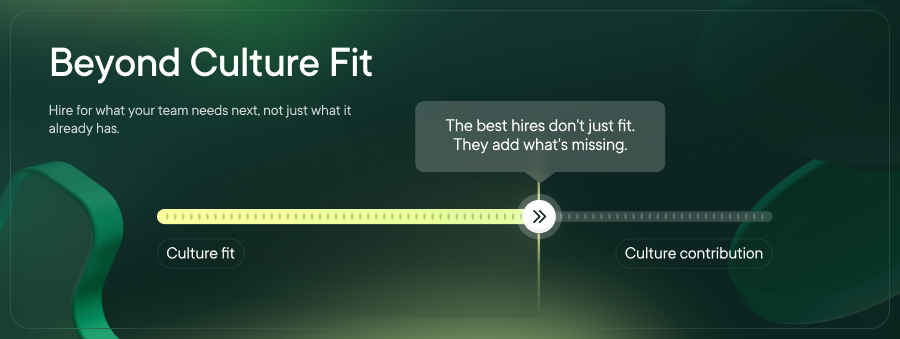
Culture fit will always involve some degree of judgement. But judgement is more reliable when it is informed by consistent, structured data from people who have actually worked with the candidate.
The most effective culture fit reference check questions are specific, behavioural, and applied consistently across every candidate. They give referees an opportunity to describe what they observed, rather than simply endorse a former colleague.
If your current reference process relies on a phone call and a couple of open-ended questions, you are leaving some of the most useful hiring intelligence on the table.
Xref Reference lets you build and deploy structured reference question sets that capture this data systematically, so your culture fit decisions are grounded in evidence, not instinct.
Uncover data-driven, actionable insights with automated reference, pulse and exit surveys.