



Human Resources
—
8
min read

Give your people a voice with a tailored Xref Engage survey.
Increase retention and reduce turnover with quick employee feedback from an Xref Pulse Survey.
The world of HR and recruitment does not slow down. Legislation shifts, workforce expectations evolve, and the tools available to hiring teams are changing faster than most organisations can keep pace with.
This is a working read for HR managers, P&C leaders, and talent professionals across the globe who want a clear-eyed view of where the industry stands right now. Five trends worth your attention, and what they mean in practice.
Here is where things stand.
AI-powered tools have become a standard part of the recruitment stack for many organisations. They screen applications, summarise candidate profiles, and in some cases, flag inconsistencies in employment history. For volume hiring roles, the efficiency gains are real.
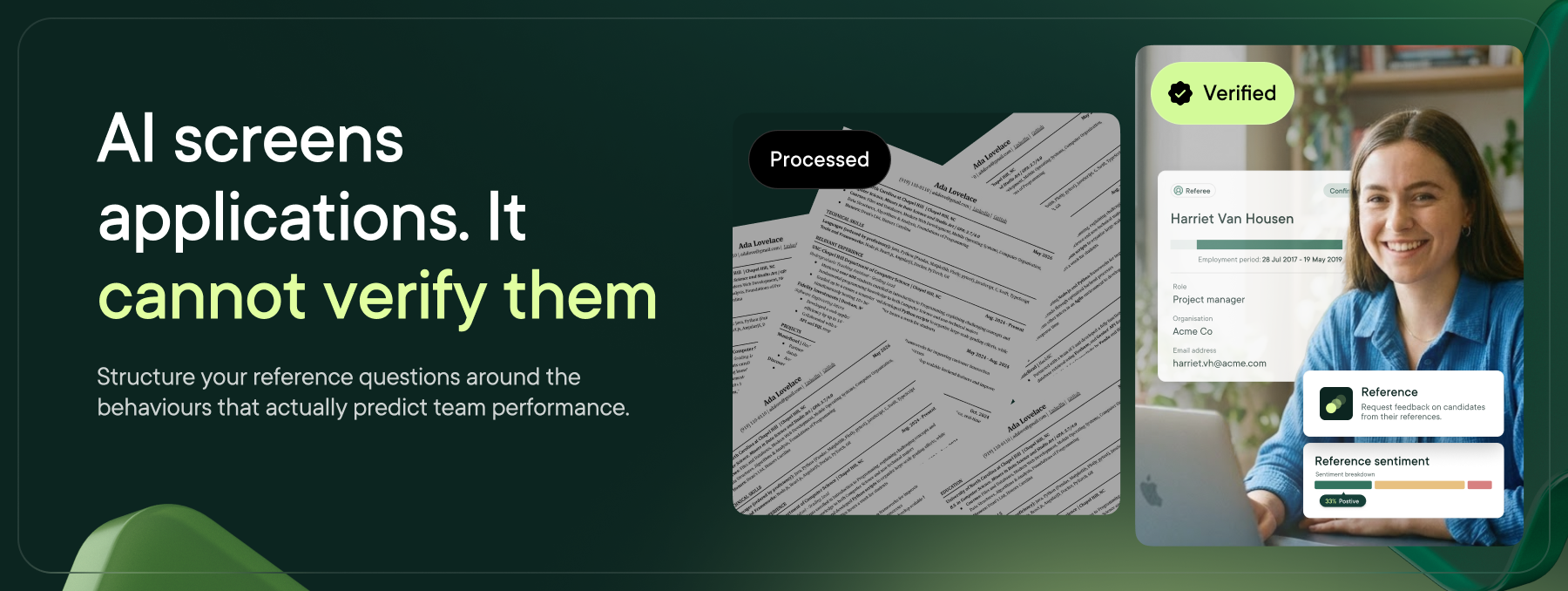
But there is a growing gap between what AI can process and what it can actually verify.
AI can read a CV. It cannot confirm that the information on it is true. That distinction matters enormously at a time when AI-generated applications have made it easier than ever for candidates to present polished, plausible, and completely fabricated credentials. Xref data shows that 75% of HR professionals have found a lie on a resume, and that was before generative tools made fabrication faster and harder to detect.
The practical implication for HR teams is this: AI screening handles volume, but it does not replace verification. Reference checking, credential validation, and background screening remain the layer where hiring confidence is actually built. Increasingly, leading organisations are treating those steps as earlier in the process, not later. Automated reference checking through Xref Reference integrates directly into this workflow, surfacing verification data at the point where it can still influence a hiring decision.
Psychosocial hazards in the workplace have been regulated across most Australian states and territories for some time now. But compliance posture varies significantly, and the gap between policy and practice remains wider than most HR leaders would be comfortable admitting publicly.
The core obligations are not new. Under harmonised WHS legislation, employers have a duty to identify and manage risks to psychological health alongside physical ones. What is shifting in 2026 is enforcement activity and employee awareness. Workers are more informed about their rights, and regulators are less inclined to treat first-instance failures as educational opportunities.
For HR teams, the priority right now is moving from reactive to proactive. That means having a genuine feedback mechanism, not just a complaints process, and being able to demonstrate that employee voice is collected systematically and acted on.
Pulse surveys have a direct role to play here. Regular, lightweight check-ins give organisations early signals on psychological safety concerns before they become formal complaints or regulatory matters. Xref Pulse is purpose-built for exactly this kind of ongoing listening, and increasingly it is being used as part of a documented psychosocial risk management framework.
Employee engagement measurement has historically been the domain of larger corporates with dedicated People Analytics functions. That is changing, and the not-for-profit and government sectors are catching up quickly.
Several factors are driving this. Workforce pressures in both sectors have intensified. NFPs are competing for talent against private sector employers who can offer higher base salaries, which puts culture and engagement in a more prominent position in the employee value proposition. Government organisations are navigating workforce transformation, hybrid working norms, and in some cases significant headcount shifts, all of which create real risk if employee sentiment is not being monitored.
The other driver is cost. Pulse survey tools have become more accessible and easier to administer without a large internal team. Monthly or quarterly survey cadences no longer require a dedicated analyst to interpret the results. For a not-for-profit with a single HR generalist or a government team running lean, that matters.
What these organisations are finding is that the data they collect from regular pulse surveys feeds directly into retention strategy. Knowing that a particular team is disengaged or that a specific manager is producing low sentiment scores gives leadership something to act on before people start resigning.
Xref Pulse was designed with exactly this kind of organisation in mind: straightforward to deploy, easy to action, and useful without requiring significant internal HR infrastructure.
The volume of AI-generated job applications is not a future problem. It is a present one.
Across the markets Xref operates in, talent acquisition teams are reporting that a meaningful share of applications they receive now include some element of AI-assisted content. Some of that is legitimate: a candidate refining their language. Some of it is not: fabricated achievements, inflated tenure, invented roles. The challenge is that without verification, it is very difficult to tell the difference.
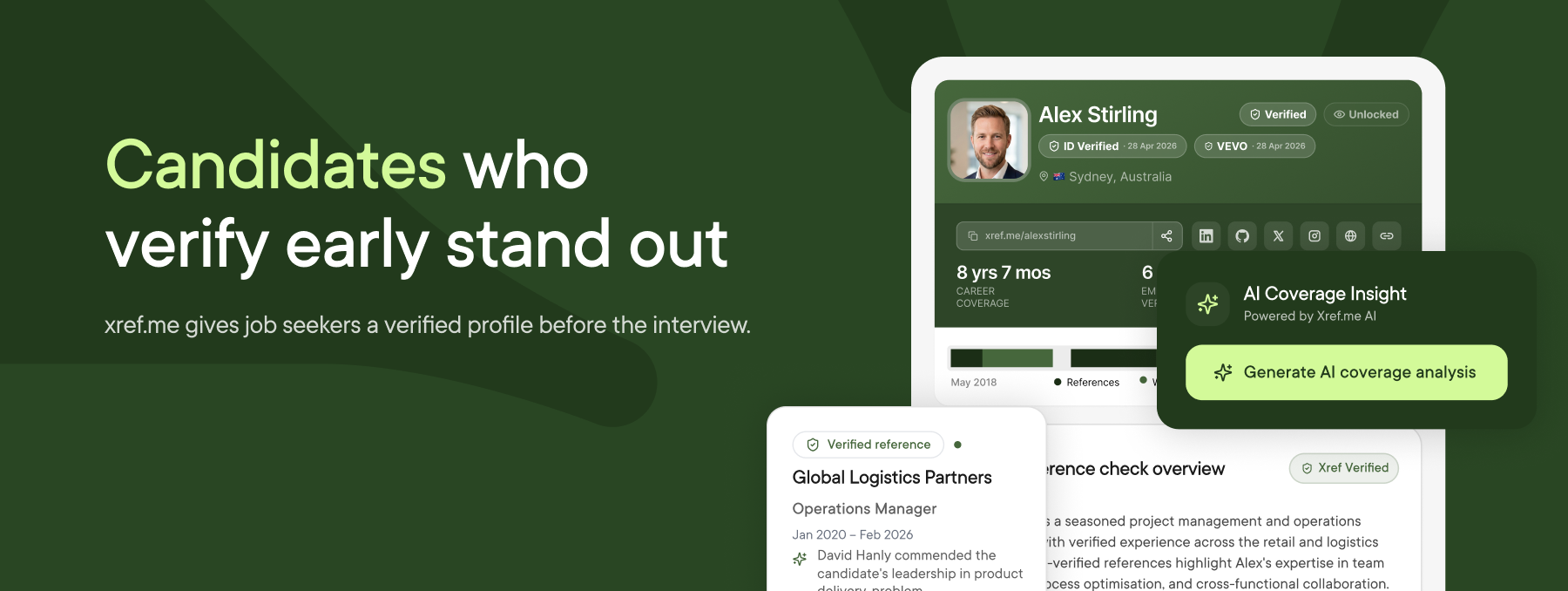
The response from the employer side is a shift toward earlier verification. Rather than treating background and reference checking as a post-offer formality, progressive HR teams are moving those steps forward in the process. The logic is straightforward: if you are going to invest interview time in a candidate, you want to know their core credentials hold up before you get there.
On the candidate side, there is a parallel shift. Job seekers who can pre-verify their employment history, qualifications, and references have a credibility advantage in a market where employer trust is increasingly strained. xref.me is a free platform that lets candidates build a verified digital profile, attaching confirmed reference outcomes and employment data to their professional identity. It is not a replacement for a CV or a LinkedIn profile. It is a verification layer that makes those things more credible.
For employers, accepting a candidate's xref.me profile as part of the application process is one of the fastest ways to establish hiring confidence before the first interview.
With the new financial year underway, retention is shaping up as the defining workforce challenge for FY27 in both Australia and New Zealand. The labour market has moderated from its post-pandemic tightness, but it has not relaxed in the ways some HR leaders anticipated. Unemployment remains relatively low in the roles that matter most to knowledge-intensive industries. At the same time, employee expectations around flexibility, recognition, and career development have not reset. If anything, they have entrenched.
What this means in practice is that organisations cannot rely on market inertia to keep their best people. The employees who are most likely to leave are often those with the most options, and they are not waiting for a bad experience to push them out. They are leaving for better ones.
Exit data is one of the most underused signals available to HR teams. Most organisations collect it inconsistently or not at all, which means they are learning about their retention problems in aggregate rather than at the root cause level. Understanding why people actually leave, from the people who left, is the most reliable way to identify what needs to change.
Xref Exit automates the exit survey process, collects candid feedback from departing employees, and helps organisations build talent pools from alumni who may be open to returning. As the labour market tightens again through FY27, that alumni pool becomes a meaningful competitive asset.
The themes above do not operate in isolation. AI in screening, psychosocial safety, verified credentials, and retention pressure are all connected by a single underlying shift: the employment relationship is under more scrutiny, from both sides, than it has been in years.
Employees are more informed, more selective, and quicker to act. Employers who have built genuine listening mechanisms, verification infrastructure, and a credible employer brand are better positioned than those still operating on the assumption that people will stay because they always have.
Uncover data-driven, actionable insights with automated reference, pulse and exit surveys.