



Human Resources
—
8
min read


Give your people a voice with a tailored Xref Engage survey.
Increase retention and reduce turnover with quick employee feedback from an Xref Pulse Survey.
You've interviewed the candidate. They presented well, their CV stacks up, and your gut says they're the right fit. But before you extend an offer, there's one step that separates confident hiring from hopeful hiring: the reference check.
The problem is that most reference checks are underbuilt. Generic questions get generic answers. Vague open-ended prompts produce polite non-commitments. And the information that would actually change a hiring decision the patterns of behaviour, the real performance data, the early warnings gets lost in the noise.
Xref has processed more than 7 million references across 195 countries. That data reveals a clear pattern: the quality of the reference check is determined almost entirely by the quality of the questions. Here's what the evidence shows.
A reference check is only as useful as the responses it generates. Poorly designed questions produce responses that confirm what you already believe, rather than revealing what you don't know. The referee wants to say something helpful. Your questions determine whether they're able to.
The most common mistake is defaulting to open-ended prompts 'Can you tell me about John?' or 'How would you describe her work style?' These questions feel conversational but they put all the cognitive work on the referee and produce responses that are difficult to compare, score, or act on.
Xref's reference data consistently shows that structured questions particularly those that ask for a rating and an explanatory comment generate significantly more detailed, useful, and comparable responses than open-ended prompts alone. Referees produce longer, more specific answers when they're given a framework to respond within.

Effective reference check questionnaires draw on three distinct categories of questions. Each serves a different purpose, and a well-built template includes all three.
These establish the factual foundation of the candidate's employment history: dates, titles, responsibilities, and the nature of the working relationship. They're not exciting, but they're non-negotiable. Xref data shows that 5% of referees correct job titles and another 5% alter employment dates. That's not a rounding error it's material information that changes hiring decisions.
Essential questions include: confirmation of employment dates, the candidate's role and level of responsibility, the nature of the referee's relationship with the candidate, and confirmation of the reason for leaving. These should always come first and should be factual and specific.
These are tailored to the requirements of the position being filled. A reference for a sales manager should ask about pipeline management and client relationship skills. A reference for a clinical role should ask about patient communication and protocol adherence. Generic templates skip this category entirely and in doing so, miss the most predictive information available.
The best role-specific questions are built from the job requirements and ask referees to comment on behaviours they would have observed directly, not traits they're inferring.
These cover the dimensions of performance that don't show up in job descriptions: how the candidate handles pressure, how they respond to feedback, how they behave in a team when things aren't going well. This is where the most revealing information tends to surface and where the quality of question design matters most.
Avoid broad questions like 'How would you describe their personality?' Referees don't know what to do with them. Instead, ask about specific observable behaviours: 'Can you describe a time when this person had to adapt their approach under significant pressure? What did that look like?'
Xref's reference data points to a clear best practice that most organisations aren't using: questions that ask for a structured rating followed by a mandatory written comment generate the most detailed and useful responses.
Here's why it works. The rating gives the referee a framework it reduces the cognitive load of producing a response from scratch. The mandatory comment then prompts them to justify and contextualise that rating. The result is a response that is both quantifiable (comparable across candidates) and qualitative (rich in specific detail).
Questions that ask only for a rating produce scores that are hard to interpret without context. Questions that ask only for written comment produce responses that are difficult to compare. The combination delivers both and it's the format that produces the longest, most specific, most useful referee responses in the dataset.
The format that produces the most detailed referee responses: a structured rating scale followed by a mandatory written explanation. Both together. Neither alone.
Reference check questions need to be structured, but they also need to be compliant. Anti-discrimination law in Australia prohibits asking about protected characteristics directly or indirectly. The BACON framework provides a practical test for every question you write:
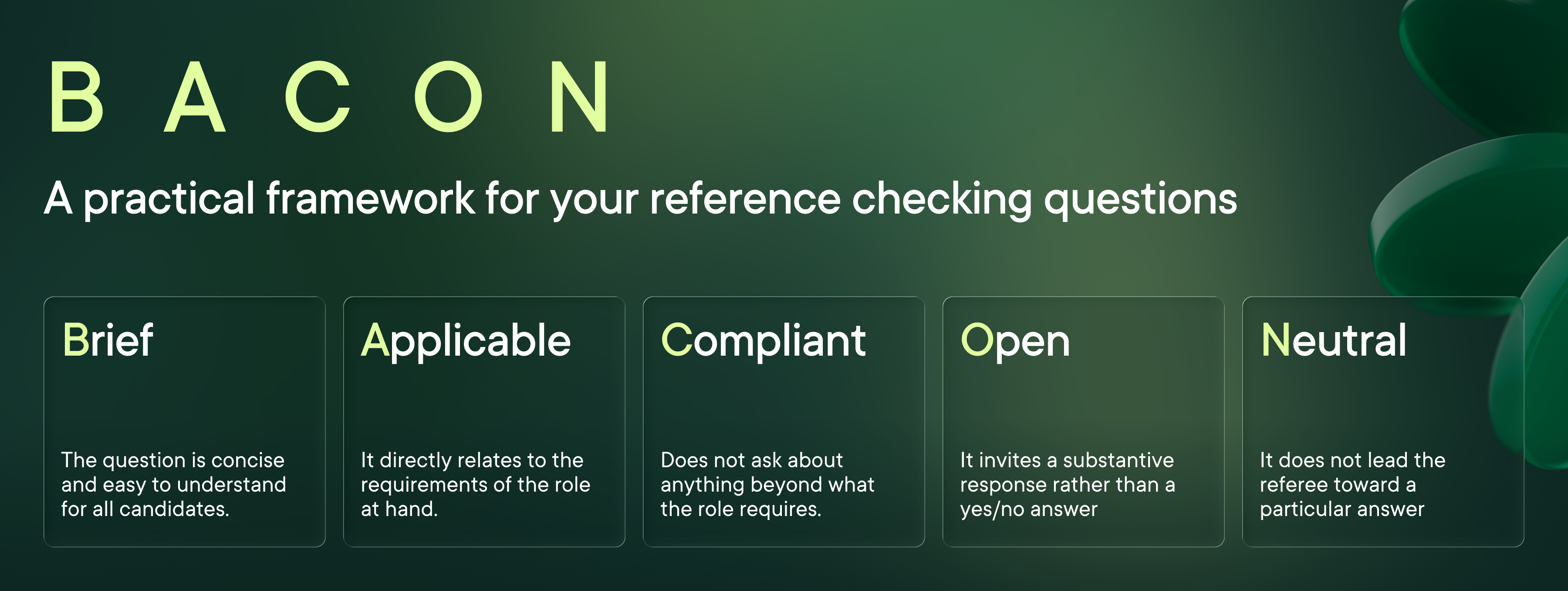
Run every question in your template through this test before sending. Questions that fail on compliance should be removed entirely, not rephrased. If you're unsure whether a question crosses a line, the safest approach is to focus on observable work behaviours rather than personal characteristics.
Xref data points to an optimal range of 9 to 18 questions per reference check. Below 9, the template doesn't gather enough information to build a meaningful picture. Above 18, referee completion rates drop and response quality starts to decline referees lose focus and responses become shorter and less specific.
Within that range, the mix matters. A well-constructed template for most professional roles includes 3 to 4 essential questions, 4 to 6 role-specific questions, and 3 to 5 personal attribute questions. Adjust the balance based on the complexity and seniority of the role.
Across Xref's reference dataset, the following question types consistently produce the most detailed and decision-relevant responses. These are not prescriptive templates they're starting points for your own questionnaire design.
On employment history:
'Can you confirm the dates of employment, the candidate's job title, and their primary responsibilities in that role?' Specific, factual, and immediately surfaces any discrepancies.
On performance:
'How would you rate this person's overall performance on a scale of 1 to 10? Please describe the specific contributions or achievements that inform your rating.' rating-plus-comment format at its most direct.
On interpersonal dynamics:
'How did this person typically approach conflict or disagreement within the team? Can you give a specific example?' Behavioural and observableural, observable, not asking for a character assessment.
On development:
'What area of professional development would you most recommend this person focus on, and why?' This reframes the weakness question in a constructive, forward-looking way that referees are more willing to engage with honestly.
On rehire:
'If you had the opportunity to work with this person again, would you do so? Please explain your answer.' the single most revealing question in any reference check. Referees who decline to answer or answer evasively are communicating something important.
Even with well-designed questions, some referees produce thin responses. Vague or brief answers are worth examining. They can indicate a referee who is unwilling to provide a candid assessment, a relationship that wasn't as close as claimed, or a candidate who has coached their referees.
Xref's algorithm monitors for unusual activity throughout the referencing process and will flag patterns that warrant further investigation, including referees who complete surveys unusually quickly, responses that closely mirror each other, and contact details that suggest the referee and candidate may be the same person. In Xref's dataset, 3% of references are confirmed fraudulent.
If a response is vague, the structural fix is better questions. If a pattern of vague responses emerges across multiple referees for the same candidate, treat it as a signal that requires follow-up before proceeding.

The most efficient approach to reference checking is a library of role-specific templates that can be deployed immediately without rebuilding from scratch for every hire. Xref's template builder allows you to create, save, and share custom questionnaires across your team with role categories, industry-specific question sets, and the ability to customise for individual roles within a standard framework.
A reference check template should be treated as a living document. Review it whenever you notice that responses are consistently thin, whenever a hire doesn't work out as expected, and at least annually to ensure questions remain aligned with role requirements and compliant with current legislation.
The reference check is not a formality at the end of the hiring process. It's the stage at which the evidence you've been building throughout the process either gets confirmed or contradicted. The questions you ask determine which.
Ready to build a reference check template backed by 7 million+ references? Explore Xref Today
Uncover data-driven, actionable insights with automated reference, pulse and exit surveys.