


Human Resources
—
7
min read


Give your people a voice with a tailored Xref Engage survey.
Increase retention and reduce turnover with quick employee feedback from an Xref Pulse Survey.
Generative AI has fundamentally transformed the talent acquisition landscape. Today, candidates can generate flawless, tailored CVs in seconds. Yet, for hiring managers and talent leaders, this abundance of polished applications has created a distinct operational paradox: applications have never looked better, but confidence in shortlists has rarely been lower.
When every application is immaculate, traditional screening tools lose their signal. The CV has largely shifted from a factual record of achievement to an unverified marketing brochure. As recruiters face an influx of hyper-optimised applications, many naturally lean on reference checks as the ultimate ground truth.
However, deep analysis of primary reference data reveals a sobering reality: traditional reference checking contains structural vulnerabilities. Reference fraud is not an isolated issue limited to fringe bad actors; it is a systematic, widespread practice that fluctuates alongside broader economic pressures and hiring behaviours.
Analysis of 3.2 million Australian candidate profiles since 2019 reveals 165,000 confirmed instances of reference fraud.
While the sheer volume of fraudulent attempts is significant, the actions taken by hiring organisations following a detection reveal an even deeper systemic issue. Out of those 165,000 flagged cases, 114,000 flags, nearly 70% were simply ignored by employers who proceeded with the hiring process regardless.
Even more concerning is the active removal of security flags. In 28% of cases (representing 47,000 records), recruiters or internal hiring teams manually overridden the system, reclassifying fraudulent entries as 'non-fraud' specifically to strip the warnings from final reporting packets.
This bypass culture carries real-world implications, particularly in high-consequence industries. Across healthcare, education, non-profit, and social assistance sectors, approximately 60,000 individuals are currently employed in critical positions despite having verified reference fraud flags on their historical records.
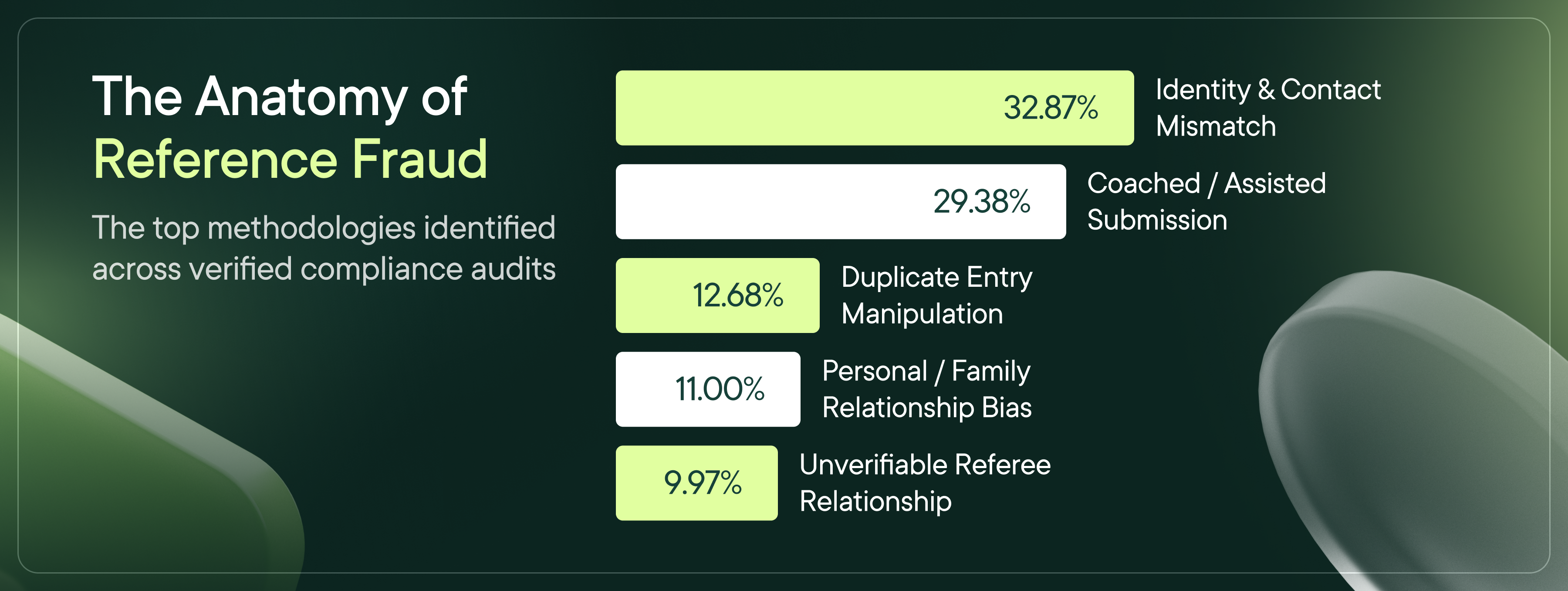
Reference fraud is rarely an elaborate, high-tech conspiracy. Instead, it typically involves everyday workarounds, mutual favors, or simple misrepresentations of personal relationships.
Data breaking down fraud types highlights the primary tactics candidates use to pass screening:
Data breaking down fraud types highlights the primary tactics candidates use to pass screening:
Auditing notes from verification workflows capture how these scenarios play out in real-world recruitment:
Two common legacy practices in talent acquisition regularly allow fraud to go undetected: the 'Rule of Two' and relying on unverified memory recall. Requesting only two references provides insufficient statistical validation. Data shows that 50% of candidates caught faking their references were asked for two referees, but could only supply one legitimate source.
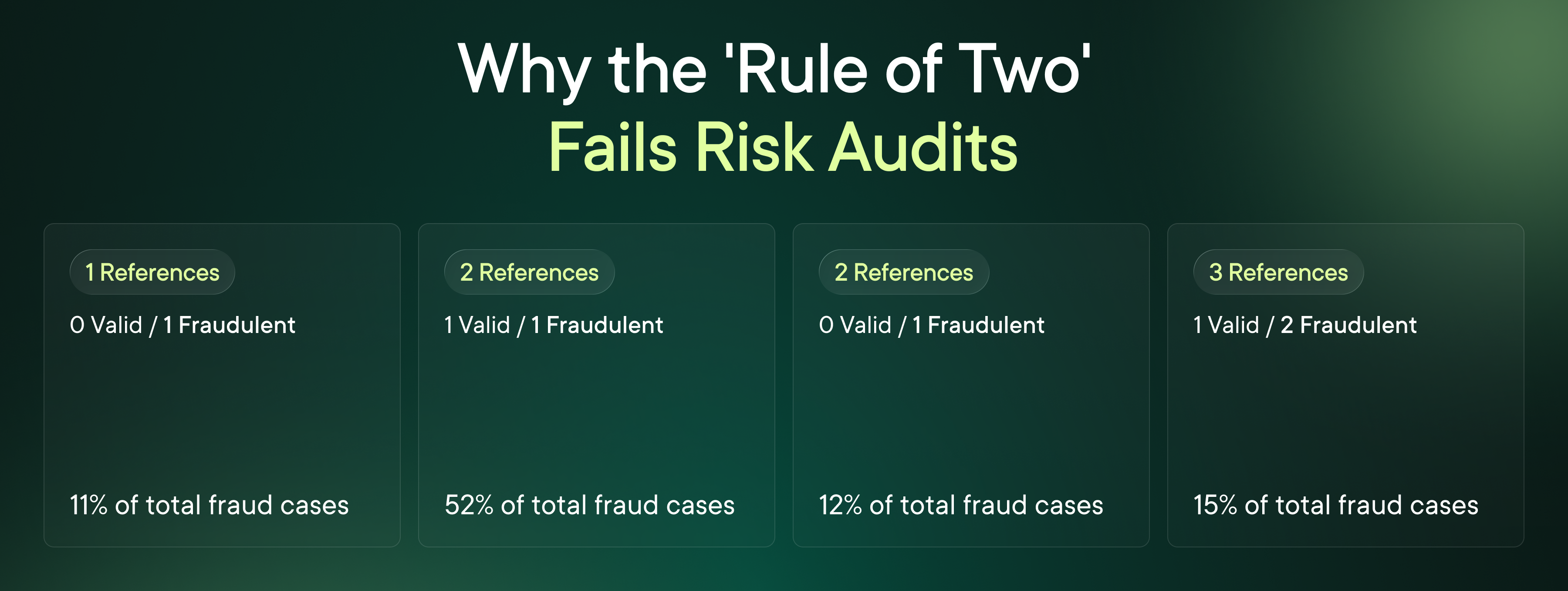
When candidates are pushed to provide three references, or when checks require continuous coverage over a 3-to-5-year timeline, unverified gaps become much harder to conceal. Furthermore, 20% of all responding referees explicitly state that their feedback covers only a portion of the candidate's claimed tenure, exposing silent gaps that traditional CV screening misses.
Traditional referencing relies on asking former managers to recall specific details about an employee's performance from several years prior. Human memory is naturally fallible. Expecting precise, unbiased feedback based on memories from half a decade ago introduces significant variance and inaccuracy into executive hiring decisions.
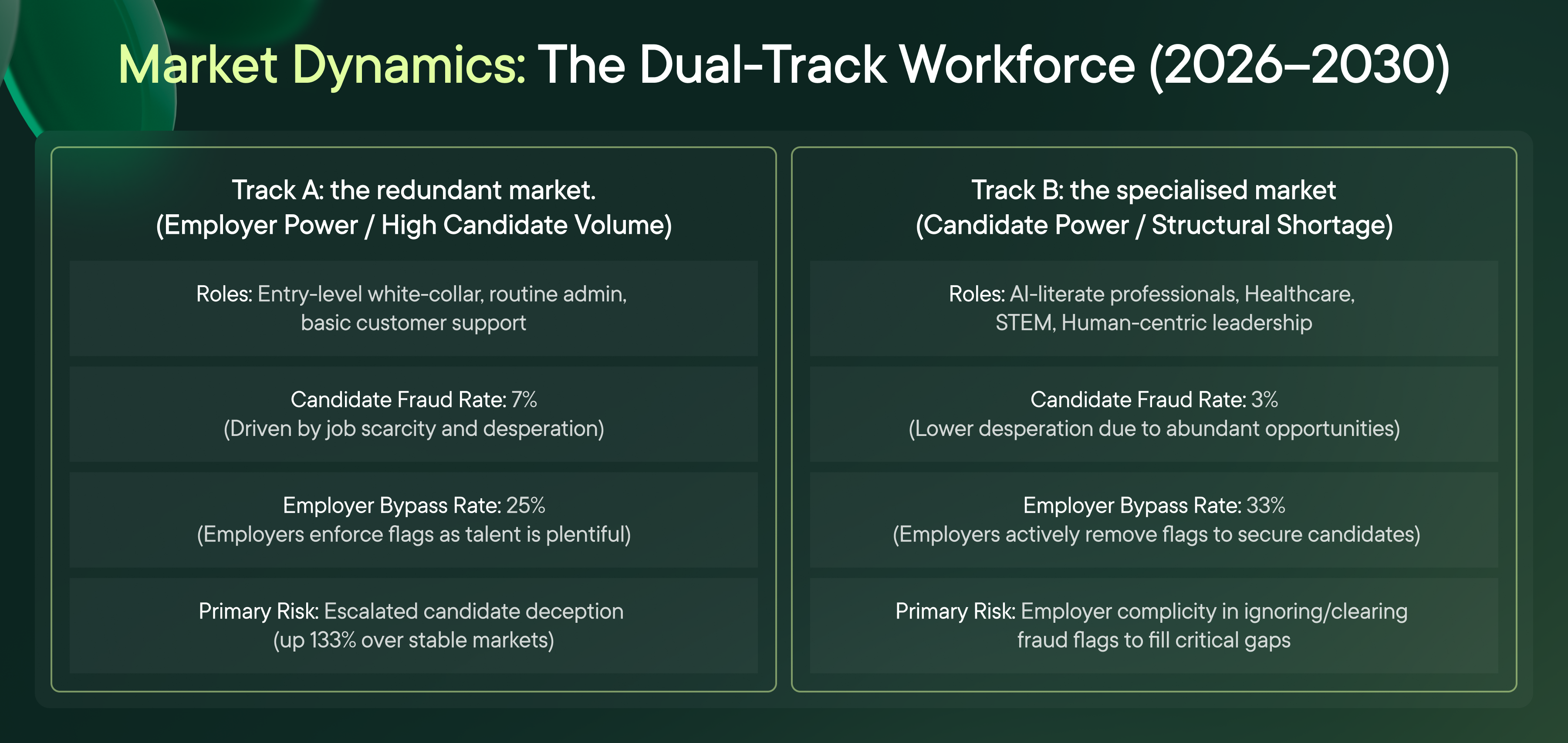
Reference fraud does not occur in a vacuum; it responds directly to economic conditions and candidate availability. Between2026 and 2030, macro trends indicate the workforce is splitting into twodistinct operational tracks, each presenting unique compliance risks.
Modern automated referencing platforms move beyond subjective impression checks, utilising multi-layered technical audits to establish authenticity.
Rather than relying on single data points, automated systems build probabilistic risk scores across key technical indicators:
When these parameters identify anomalies, an 'Unusual Activity' flag is attached to the candidate file. Crucially, an automated flag does not represent an automatic rejection. It serves as a prompt for internal recruitment teams to conduct a manual review, document the findings within an immutable audit trail, and verify legitimate context where applicable.
Relying on traditional, end-of-funnel reference calls creates operational friction, prolongs time-to-hire, and leaves organisations exposed to preventable compliance risks.
To build resilient, high-trust recruitment workflows, talent acquisition leaders should consider three key operational shifts:
By replacing legacy habits with transparent, data-verified screening, organisations can protect their teams, streamline hiring pipelines, and ensure that candidate evaluations are built on verified truth.
Don't let legacy habits or unverified checks compromise your hiring decisions. Xref automates reference checking to deliver secure, data-verified insights early in your recruitment workflow, helping you build high-trust teams with total confidence.
Uncover data-driven, actionable insights with automated reference, pulse and exit surveys.