



Human Resources
—
7
min read


Give your people a voice with a tailored Xref Engage survey.
Increase retention and reduce turnover with quick employee feedback from an Xref Pulse Survey.
If you've ever had a high performer hand in their resignation and felt completely blindsided, you're not alone. The gap between how leadership thinks employees are feeling and how employees actually feel is one of the most persistent problems in people management, it rarely closes on its own.
Employee pulse surveys exist to close that gap. They give People and Culture leaders a regular, lightweight way to check in on the mood of the organisation without waiting for an annual survey cycle, an exit interview, or a wave of resignations to tell them something's gone wrong.
This guide explains what pulse surveys are, how they differ from annual engagement surveys, and how to build a cadence that works, without wearing out your team.
A pulse survey is a short, frequent survey sent to employees to gauge how they're feeling about their work, team, or organisation at a given moment. Unlike annual engagement surveys, which attempt to capture a comprehensive picture once a year, pulse surveys are designed to be quick to complete and quick to act on.
Most pulse surveys contain between 3 and 15 questions. They take employees two to five minutes to complete. They're sent weekly, fortnightly, or monthly depending on the organisation's goals and capacity.
The name is deliberately chosen: just as checking your pulse tells you something about your body's current state, a pulse survey tells you something about the current health of your organisation. It's a vital sign, not a full diagnostic.
Both pulse surveys and annual engagement surveys have a role to play, but they serve different purposes. Understanding the distinction helps you decide when to use each, and why running both is worth the investment.
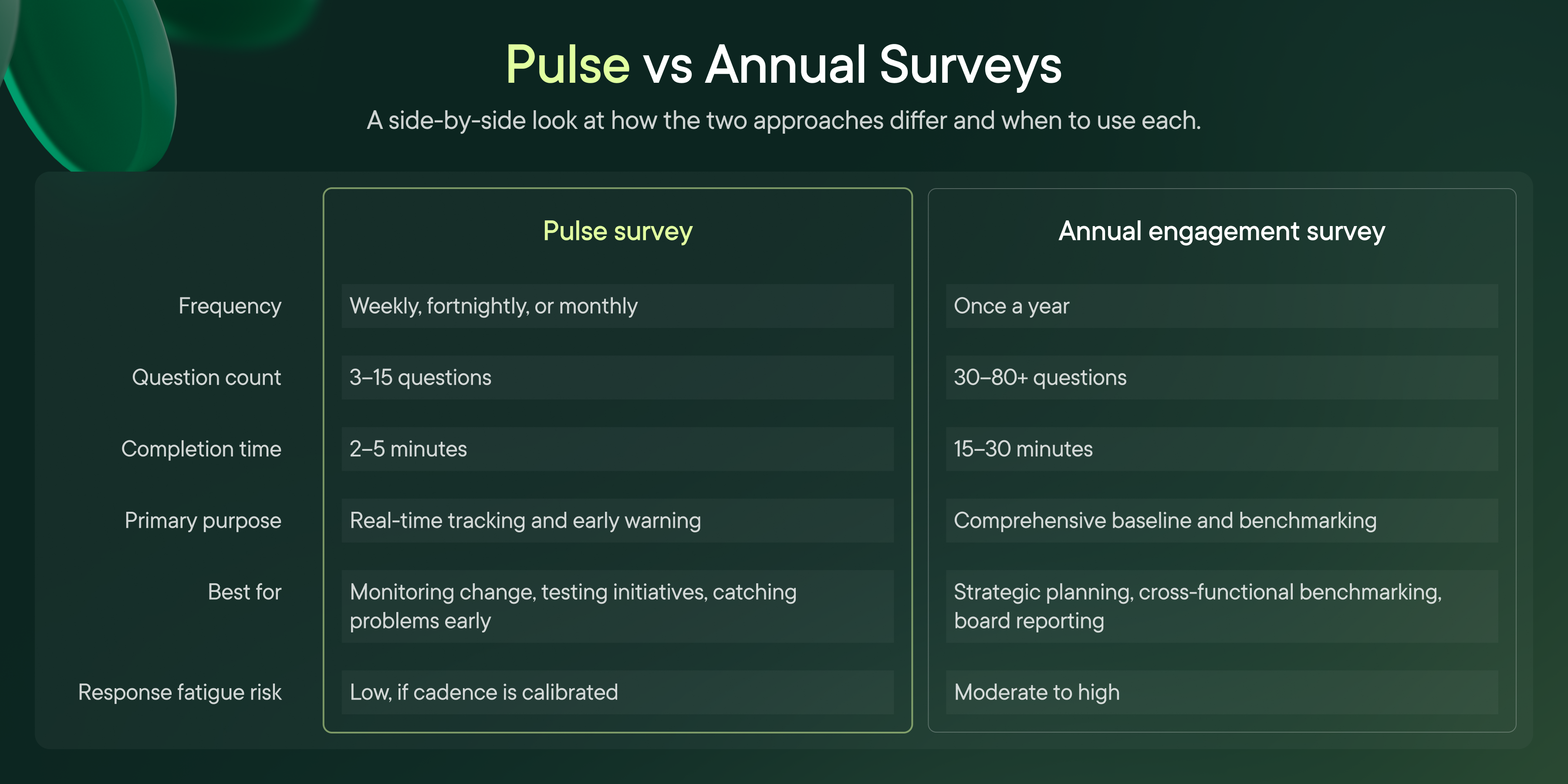
Pulse surveys are powerful, but they're not a substitute for deeper listening. It helps to be clear on where they add the most value.
There's no single right answer, but there are useful principles.
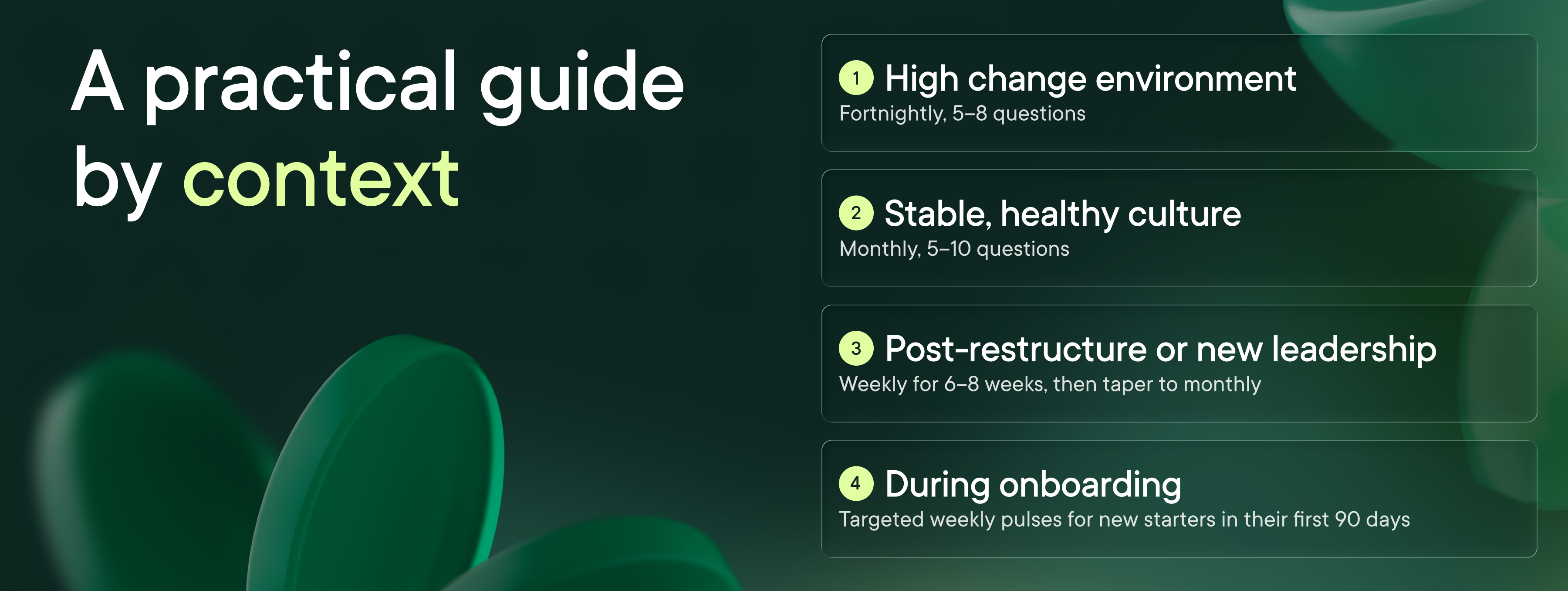
Weekly pulses work well for organisations going through significant change, a merger, a restructure, a major culture initiative. They create a high-frequency feedback loop that lets leaders respond quickly. The risk is fatigue: weekly surveys only work if questions are very short (three to five at most) and if managers are actually doing something with the results.
Fortnightly or monthly pulses are the most common and generally the most sustainable. They give employees enough breathing room to answer thoughtfully without the feedback loop becoming so slow that results feel dated by the time you act on them.
Quarterly pulses sit closer to the "light-touch annual survey" end of the spectrum. They're better suited to organisations that have a strong annual survey in place and want occasional temperature checks in between, rather than organisations using pulse surveys as their primary listening mechanism.
The quality of your questions determines the quality of your data. A few principles worth holding to:
Keep it to one idea per question: "I feel supported by my manager and have clear direction on my goals" is two questions. Split them.
Use consistent response scales: Agree/disagree scales or numeric scales (1–5 or 1–10) make it easier to track movement over time. If you change your scale mid-stream, you lose comparability.
Mix quantitative and qualitative: Rated questions give you trend data. One open-text question per survey. "Is there anything on your mind this week?" or "What's one thing that would make your job easier right now?". This gives you the texture behind the numbers.
Focus on actionable themes: If you can't do anything with the answer, reconsider the question. "Do you feel the company's five-year vision is clearly communicated?" is only worth asking if leadership is prepared to respond if the answer is no.
Rotate topics deliberately: Don't ask the same questions every week. Rotate across themes recognition, workload, manager relationship, team connection, clarity of direction, so you build a broad picture over time.
Survey fatigue is real but it's almost never caused by too many surveys. It's caused by surveys that feel pointless.
When employees complete a survey and nothing changes, they stop completing surveys. It's rational. The fastest way to kill participation is to ask for feedback and visibly ignore it.
This doesn't mean every piece of feedback requires a company-wide response. But it does mean employees need to see that results are being read, considered, and acted on where possible.
A few habits that help:
Close the loop quickly. Share a summary of results, including the honest ones, within a week of closing the survey. Acknowledging what came up, even before you've decided what to do about it, signals that the feedback was heard.
Separate signal from noise. Not every result requires action. A dip in one week's scores might reflect a hard deadline, a difficult meeting, or a rough news cycle, not a structural problem. Track trends over multiple cycles before making significant decisions based on a single data point.
Give managers their team's data. Organisation-wide results are useful for HR. Team-level results are what drive change. When managers can see how their specific team is feeling and are supported to respond to it, engagement improves.
Celebrate movement. When something improves, when a score that's been flat for three months starts rising, say so. Tell the team what changed and connect it to the feedback they provided. This is how you build a culture where people believe that speaking up actually works.
Organisations that stop running pulse surveys often find out why they needed them only after they've stopped.
Engagement problems rarely announce themselves loudly. They build quietly, in the gap between how an employee talks about their job to a friend and how they answer in a performance review. Pulse surveys give people a structured, low-stakes way to be honest. Without that channel, honest feedback doesn't disappear. It just migrates somewhere else: to exit interviews, to Glassdoor, to the team member who's connected to your best people on LinkedIn.
Running pulse surveys consistently is, at its core, a statement about what kind of employer you want to be. It says: we want to know, even when it's uncomfortable. We'd rather hear it now than find out too late.
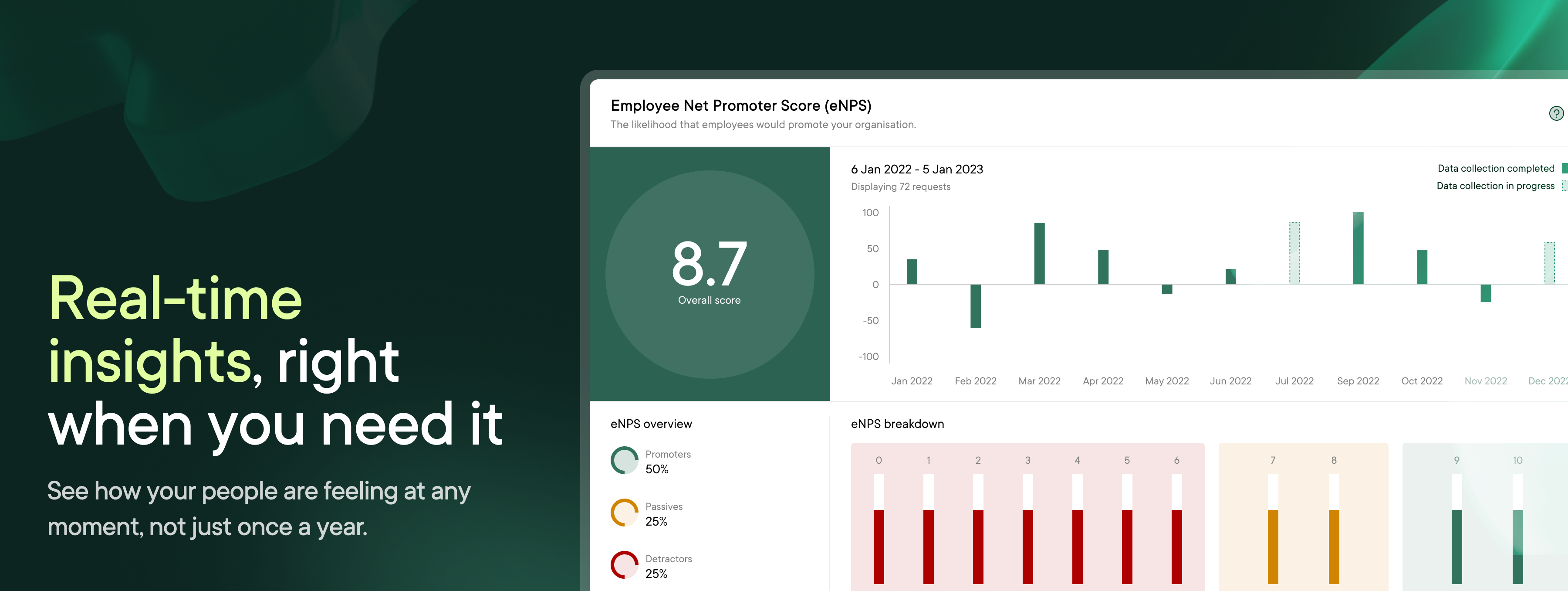
Xref Pulse is built for teams that want a lightweight, repeatable way to stay across how their people are feeling. It sits alongside Xref Engage, which provides deeper, psychologist-designed engagement surveys. Giving P&C teams both a real-time listening tool and the depth they need for strategic workforce planning.
Pulse surveys don't require a large HR function to run effectively. They require a clear cadence, good questions, and the commitment to do something with what you learn.
If you're starting from scratch or looking to improve what you've already built, explore Xref Pulse to see how other organisations are making ongoing listening a practical habit, not a once-a-year project.
Uncover data-driven, actionable insights with automated reference, pulse and exit surveys.