



Human Resources
—
8
min read

Give your people a voice with a tailored Xref Engage survey.
Increase retention and reduce turnover with quick employee feedback from an Xref Pulse Survey.
Nine hours a week. That is how much time the average manager now spends on their team's personal and emotional concerns, on top of everything else the job already asked of them.
Gartner's newest survey of the state of people management, drawn from 2,947 employees and managers surveyed in November and December 2025, found that 47% of managers say more is expected of them and that they are working harder than they were a year ago. Some of that shows up as hours on a calendar. What almost no organisation can see is whether any of that effort is actually making anyone a better manager.
Ask most people what a manager's job looks like on paper and they will describe budgets, timelines, one-on-ones, and performance reviews. Ask what it looks like this year, and the picture has shifted. Managers are now spending an average of nine hours a week, more than 20% of their working time, addressing employees' personal and emotional concerns rather than the tasks that used to define the role.
That change did not happen because managers decided to take on more pastoral duty. It's a reasonable bet that it happened because the people reporting to them are bringing more to the table: financial stress, caring responsibilities, burnout, uncertainty about job security.
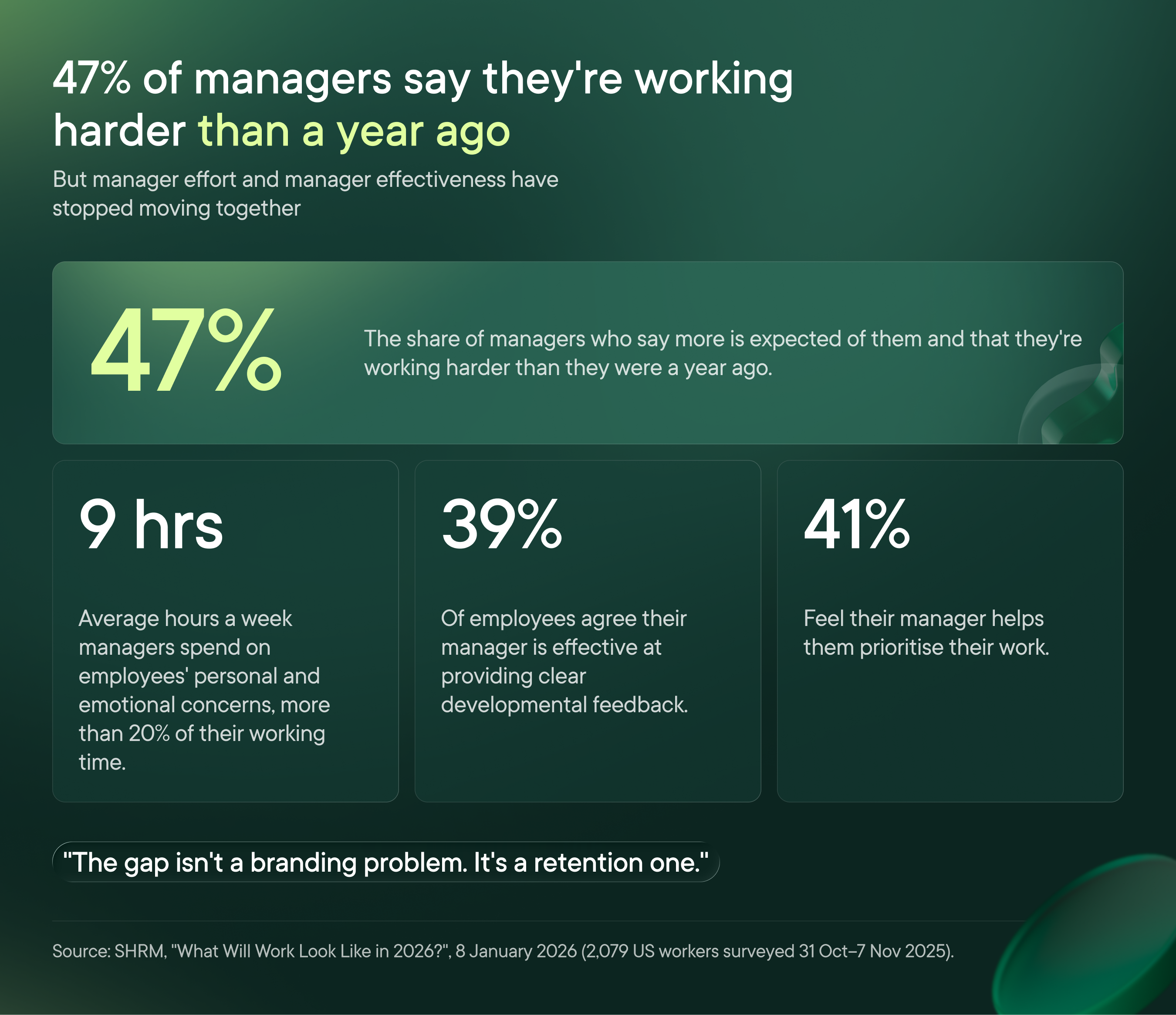
Rising effort would be easier to accept if it were producing rising results. It is not. Only 39% of employees agree that their manager is effective at providing clear developmental feedback, and just 41% feel their manager helps them prioritise their work.
Put those two findings side by side and a real mismatch appears. Managers are pouring hours into their people. Fewer than four in ten of those people think it is landing as useful feedback. Something is absorbing all that extra effort before it reaches the person it was meant for.
Re-establish management fundamentals. Expect and accept some employee dissatisfaction. Reset manager objectivity toward the team's mission. Those are Gartner's own three recommendations, released alongside the same data, and every one of them is aimed at manager behaviour.
A manager who genuinely follows all three still cannot tell whether it is sinking in, because in most organisations the only system checking on them runs once a year, from above. If their day-to-day effort is not registering with the people who experience it, nobody finds out until the next annual review, by which point a year's worth of nine-hour weeks has already gone into a black box.
Here is the part an annual review structurally cannot fix: a manager's performance is almost always rated by their own manager, not by the people who experience their management day to day. It is a familiar shape in reference checking too, where quantified feedback drawn from a single referee is sometimes treated as though it settles the question of how someone actually performs, when one data point rarely does. Applied to the people already inside an organisation, the same limitation holds. One person's opinion, filed once a year, is not a measurement system.
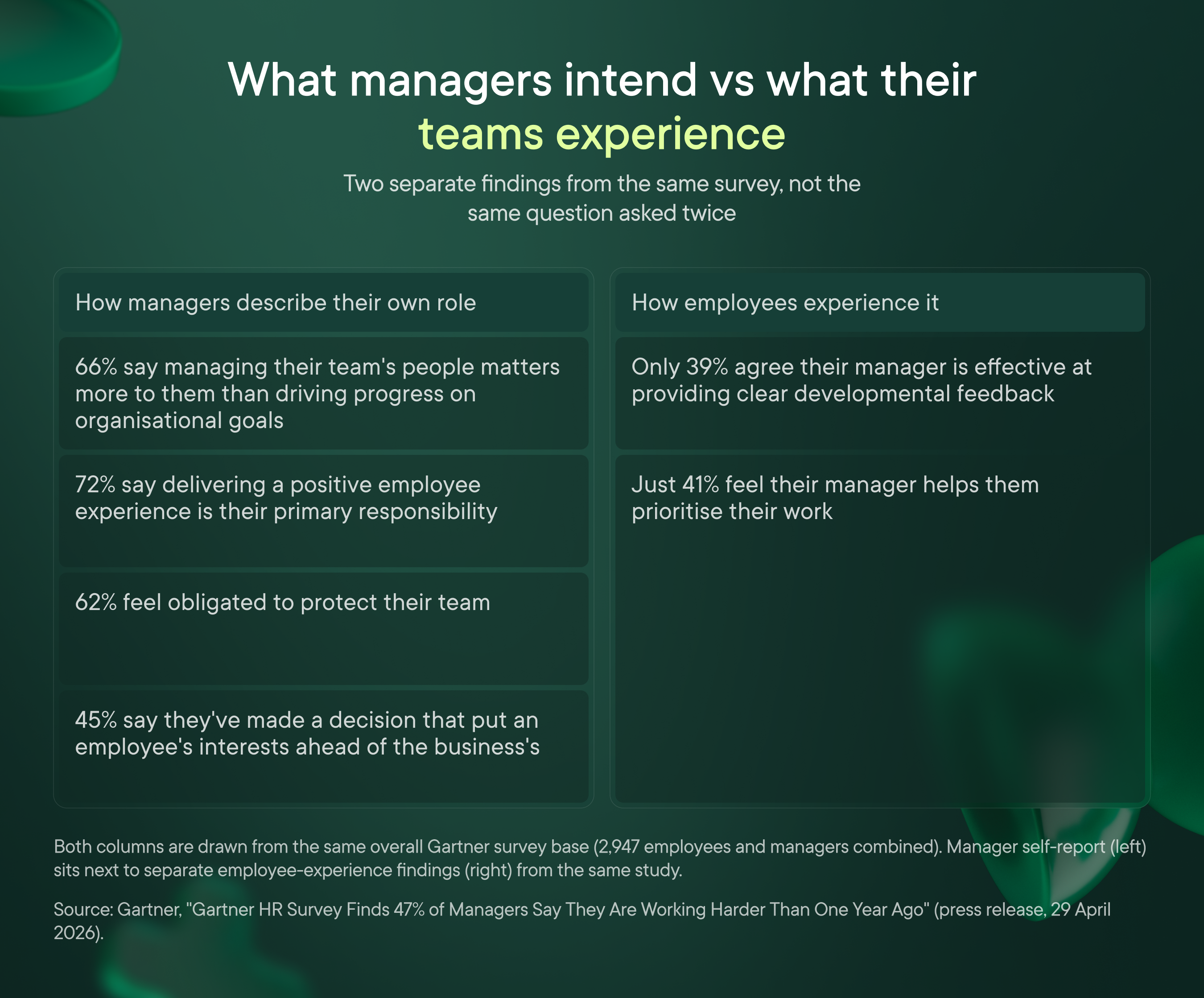
In the same survey, managers describe their own priorities in fairly demanding terms. 66% say managing their team's people matters more to them than driving progress on organisational goals, 72% say delivering a positive employee experience is their primary responsibility, 62% feel obligated to protect their team, and 45% say they have made a decision that put an employee's interests ahead of the business's. Those numbers describe what managers intend, not what their teams actually experience, because nobody in the same survey was asked to rate the managers back.
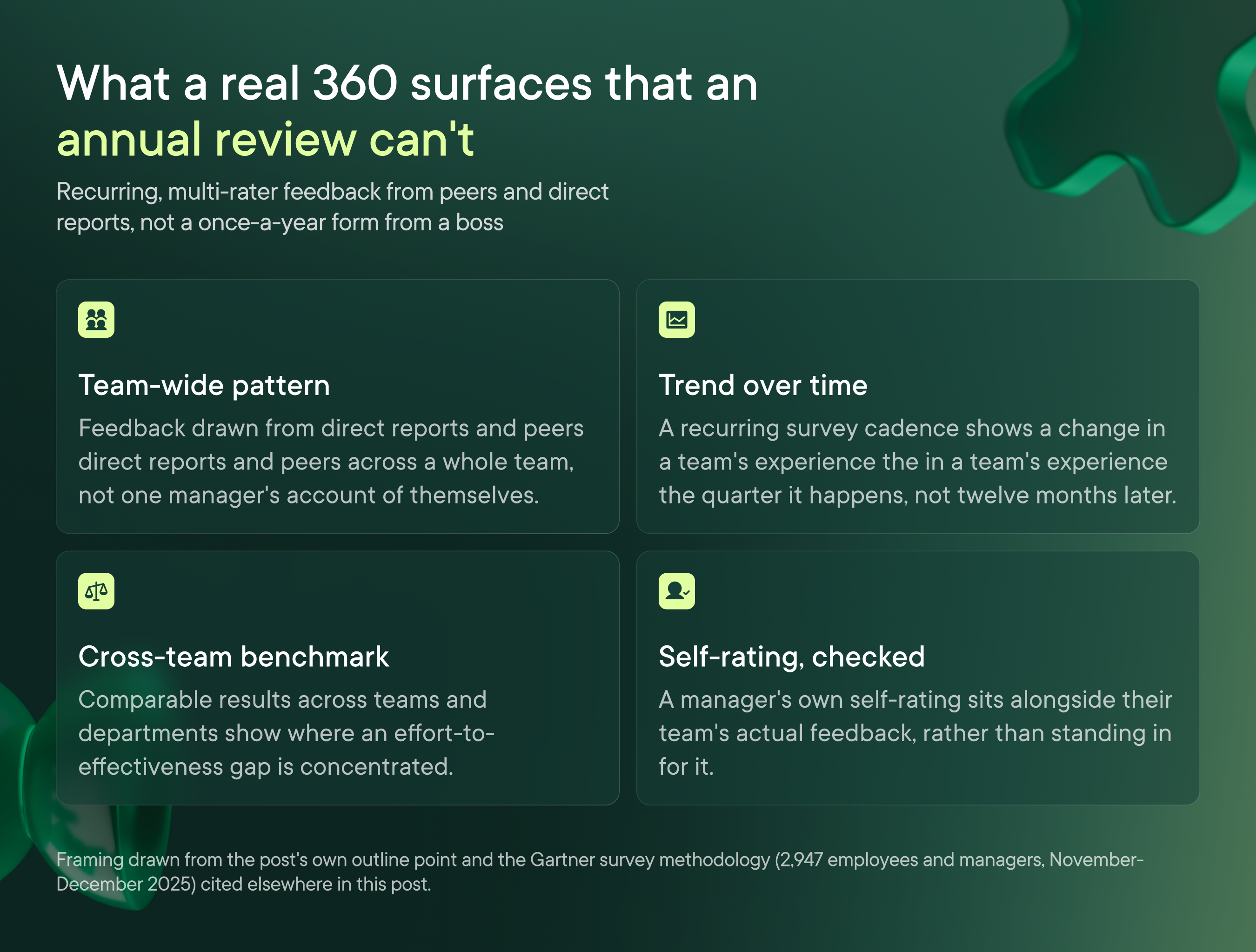
None of that is something Gartner's survey measured, it's what a recurring, multi-rater system adds on top. A recurring 360, one that pulls in a manager's self-rating alongside input from direct reports and peers rather than a once-a-year form filled out by a boss, surfaces three things a top-down review structurally cannot.
The first is a pattern across a whole team, not one manager's account of themselves. The second is a trend over time, so a change in how a team experiences its manager's feedback is visible the quarter it happens rather than twelve months later. The third is a benchmark against other teams and departments, which is the only way to tell whether an effort-to-effectiveness gap is a single team's problem or something spread across the organisation.
It does not ask a manager to work any harder than they already are, only for the organisation to build a feedback loop that closes, instead of one that only ever points upward.
The honest response to 47% of managers working harder is not to ask for a 48th percentage point of effort next year. It is to give the organisation a way of seeing where that effort is landing, so coaching and support can go to the teams the data actually flags rather than being spread evenly on the assumption that every team needs the same thing.
Xref Engage's Leadership 360 surveys are built to sit inside exactly that gap, alongside its Pulse and Employee Engagement surveys: recurring, multi-rater feedback from peers and direct reports rather than the one review a year that only ever looks upward. Talk to Xref's team about building that loop before another nine-hour week goes unmeasured.
Uncover data-driven, actionable insights with automated reference, pulse and exit surveys.