


Human Resources
—
7
min read


Give your people a voice with a tailored Xref Engage survey.
Increase retention and reduce turnover with quick employee feedback from an Xref Pulse Survey.
Gartner recently put a name to an issue HR leaders have dealt with for years. In its 2026 Future of Work trends for CHROs, the research firm highlighted culture dissonance : the widening gap between the values an organisation advertises and the actual daily experience of its staff.
The label might be new, but the underlying issue is well-established. SHRM’s 2026 research highlights the real-world impact of this disconnect. Over the past year, maintaining company culture shifted from a minor background item to a primary focus for CHROs. The same data demonstrates that job satisfaction and staff retention depend directly on whether employees feel their organisation actually practices what it preaches.
Kaelyn Lowmaster, Director in Gartner’s HR practice, summed it up during the report's release: "This is leading to cultural dissonance, when culture no longer reflects the reality of work." (Gartner, 12 January 2026)
At its core, the concept is straightforward. Every organisation operates with two distinct cultures:
Culture dissonance sets in when the gap between these two experiences grows so wide that employees stop trusting official communications altogether.
This disconnect is far more than an internal branding issue. SHRM’s 2026 State of the Workplace report, which surveyed 2,079 US workers, found that 91% of employees who feel their organisation effectively supports workplace needs report being satisfied with their job. By comparison, only 44% of employees at organisations viewed as ineffective feel the same way. That 47-point drop in satisfaction relies heavily on whether staff believe company messaging reflects reality. (SHRM, 8 January 2026)
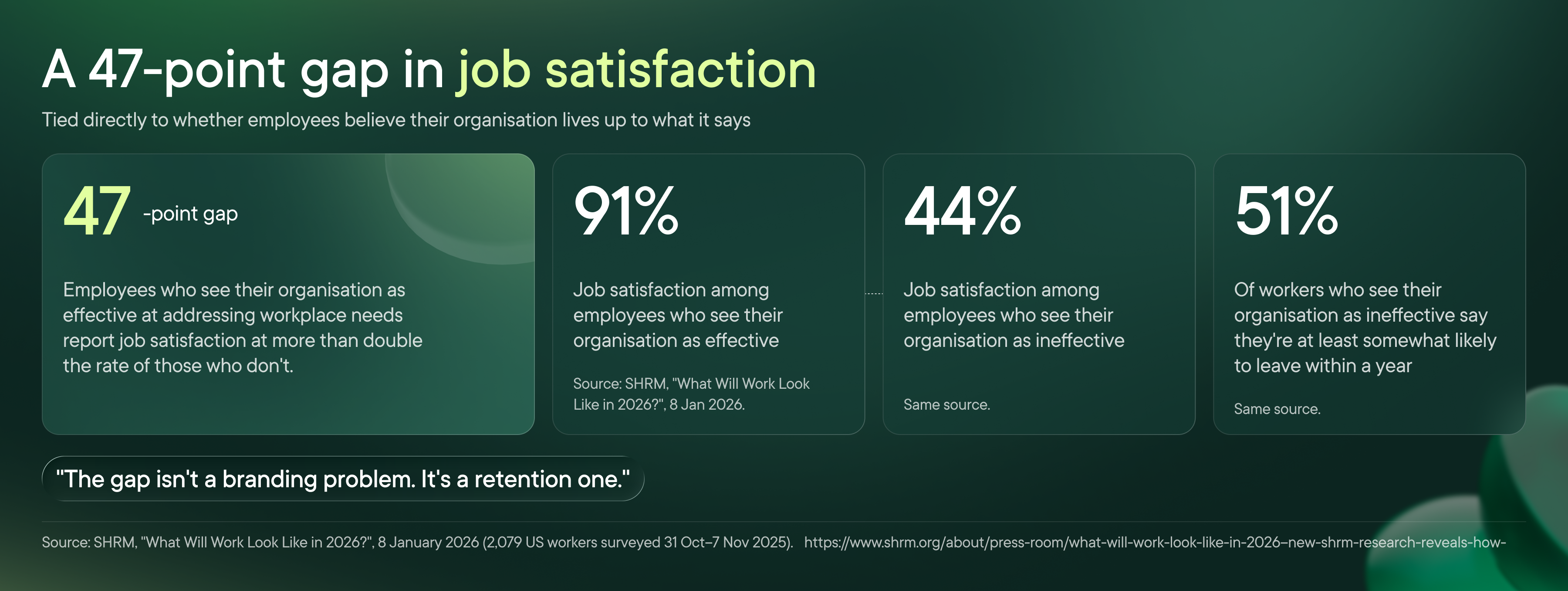
The study also showed that 51% of employees who view their workplace as ineffective plan to leave within 12 months. Staff do not need survey results to tell them the working environment falls short of expectations. They notice it daily, and the high performers who catch on first are usually the hardest to replace.
Worker expectations are also climbing. SHRM’s research found 72% of HR professionals and executives agree that employees demand far more from employers today than in past years. Company culture statements that went unquestioned five years ago are now heavily scrutinised against everyday realities.
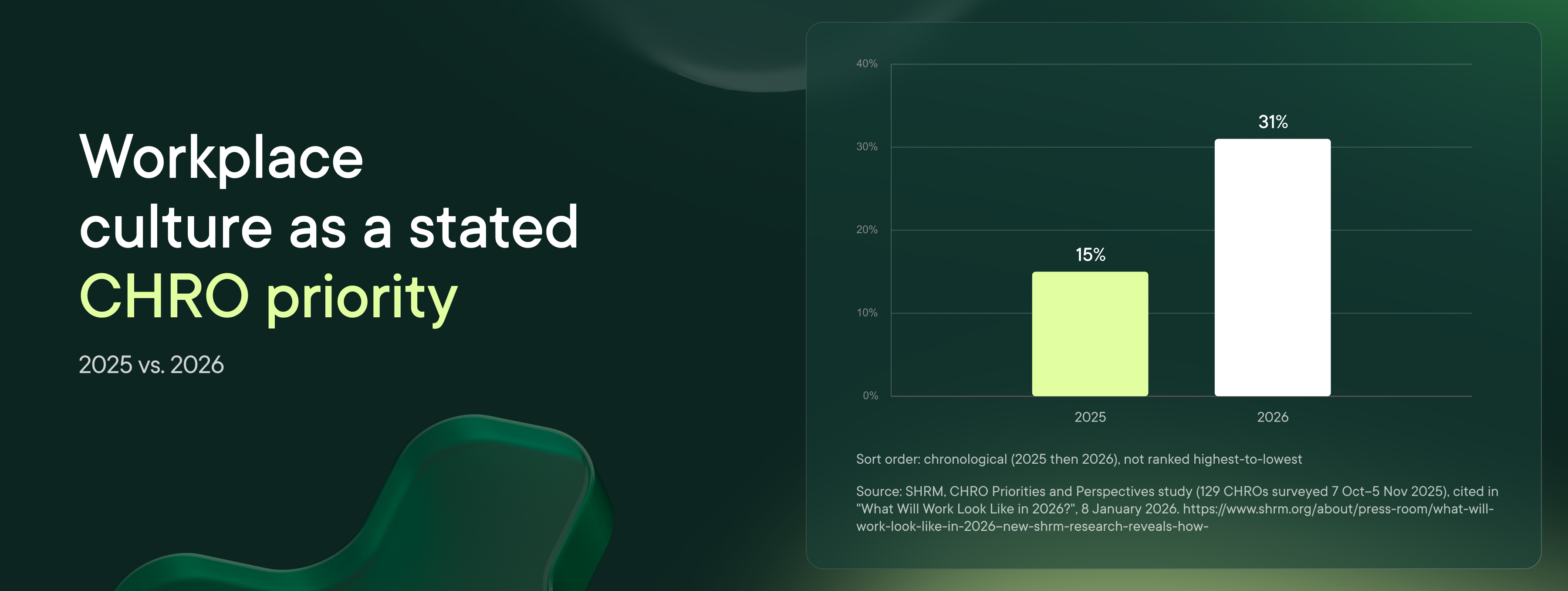
Data from SHRM’s CHRO Priorities and Perspectives survey (conducted among 129 CHROs in late 2025) shows culture jumping from 15% of key CHRO priorities in 2025 to 31% in 2026, effectively doubling in twelve months. Meanwhile, leadership and manager development maintained its spot as a primary focus for 46% of CHROs. (SHRM, 8 January 2026)
These numbers reflect a clear shift: HR leaders recognise that workforce dynamics have changed and need tools to fix cultural drag before it drives talent away. What many lack is a system to detect these gaps before significant damage occurs.
It is easy to assume culture dissonance comes from executives making promises they do not intend to keep. In reality, leadership teams usually mean what they say when drafting company values. The problem is that operational reality constantly shifts under the weight of hiring freezes, restructures, and heavier workloads, while employee feedback mechanisms stay static.
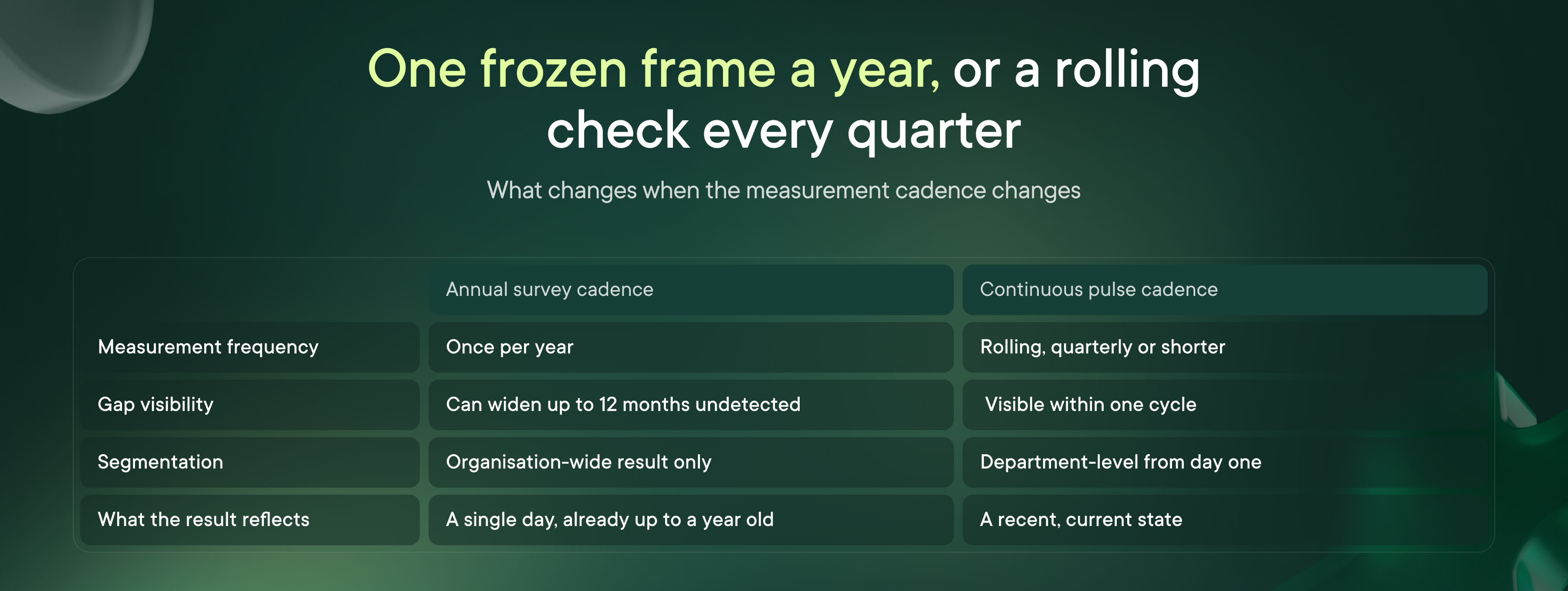
An annual engagement survey provides a single static benchmark. It measures how closely the lived culture aligned with the stated culture on one specific day of the year. During the 364 days between surveys, disconnects form and compound unnoticed. By the time the next annual survey arrives, leadership is looking at twelve months of unaddressed friction, and often a trail of resignation letters.
This explains why culture dissonance affects even well-intentioned companies. Broad values mean little without consistent measurement.
Fixing this problem requires measuring workplace sentiment more frequently, catching minor issues before they turn into year-end turnover spikes.
This is the primary function of pulse surveys: quick, targeted feedback rounds run alongside or between larger annual assessments. They track key metrics like eNPS on an ongoing basis and break down feedback by department so isolated team issues do not get hidden by organisation-wide averages.
Xref’s Pulse Surveys platform is designed around this approach:
Frequent pulse updates do not eliminate the need for comprehensive annual or bi-annual reviews, which remain useful for long-term benchmarking. Instead, regular check-ins offer an early warning system, allowing HR teams to fix localised issues while they are still manageable. For a deeper look into survey intervals, read Xref's full guide: What Is an Employee Pulse Survey and How Often Should You Run One?
Transitioning to continuous listening does not mean scrapping your current annual survey or launching an elaborate new programme overnight. Focus on these actionable steps:
A costly cultural gap should not take a full year to identify. Explore Xref Pulse Surveys to see how regular pulse checks can strengthen your current employee engagement strategy.
Uncover data-driven, actionable insights with automated reference, pulse and exit surveys.