



Human Resources
—
7
min read


Give your people a voice with a tailored Xref Engage survey.
Increase retention and reduce turnover with quick employee feedback from an Xref Pulse Survey.
Organisations are spending more than ever to move existing employees into new roles, yet the rate at which that actually happens hasn't shifted.
Gartner named this exact pattern as one of four trends talent management leaders should prepare for in 2026, framing it as HR turning roughly a third of its recruiting capacity inward toward the people already on the payroll. The reason is blunt: as roles get created and restructured, Gartner expects roughly one in five employees will need to be redeployed into a different job by 2030, and most organisations aren't set up for it. Investment in internal mobility has gone up. The mobility itself hasn't. Get the redeployment decision wrong and the cost shows up later rather than sooner: a lateral move made on a guess, a skills gap that surfaces three months in rather than before anyone signed off on it.
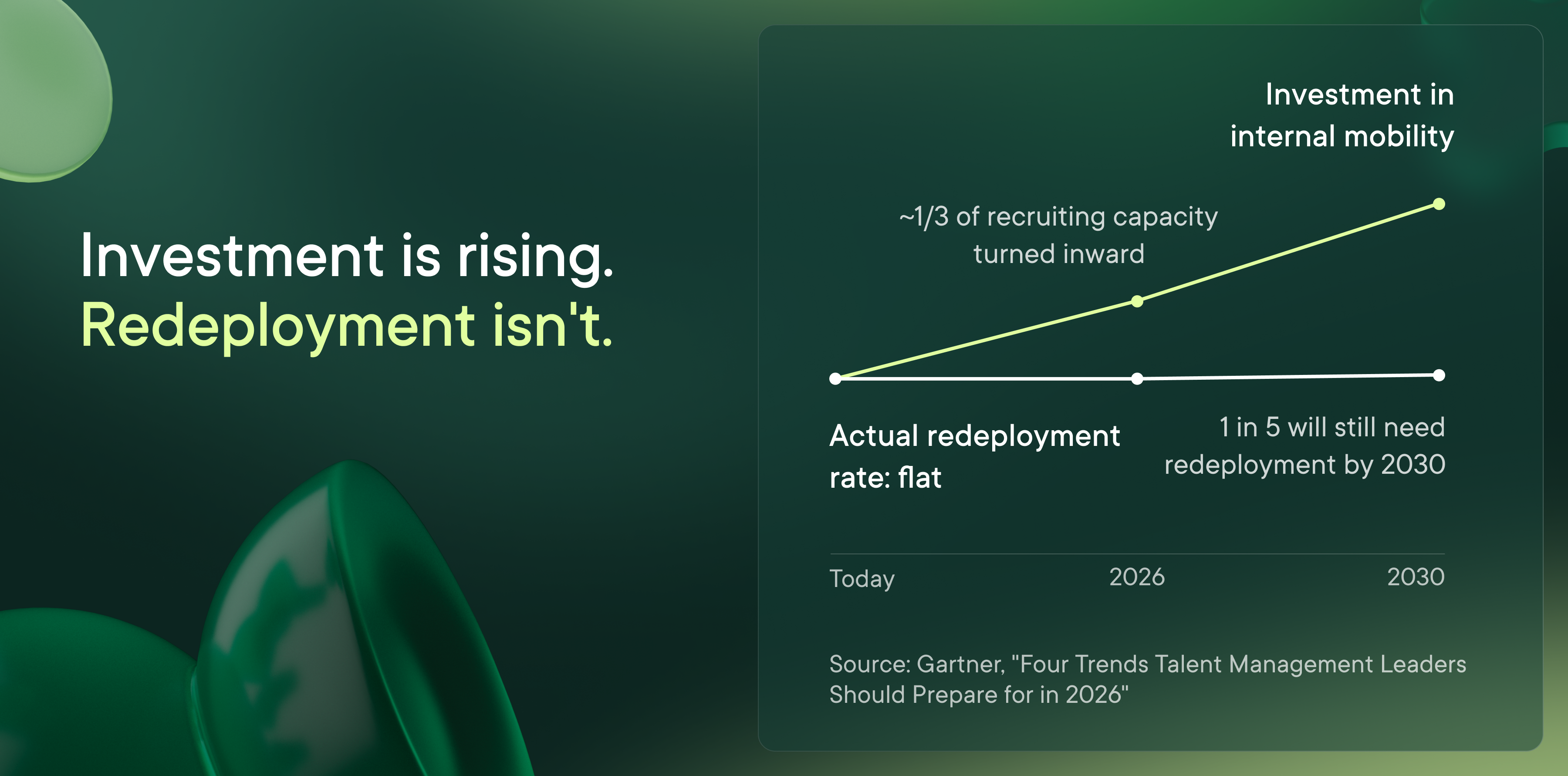
The fix, according to Gartner's own research, starts with data, not process. That research tells talent leaders to make sure information about employees' skills stays current and easy to find, so recruiting teams can be proactive about matching people to redeployment opportunities before a role even opens. That's a specific, practical instruction, and it points straight at the real bottleneck. Employee skills data that's accurate and current is exactly what most organisations don't have, not because nobody's tried to collect it, but because the data an internal mobility decision runs on has never been built with the same discipline as the data behind a hiring decision. A hiring decision comes with a paper trail almost by design, whether or not a redeployment decision ever does.
What does an external candidate get before anyone offers them the role? A resume screen, interviews, and for most employers today, an independently verified reference check that measures their skills, competencies and work history against what a former employer actually observed firsthand. How well one interviewer happened to like them doesn't factor into it.
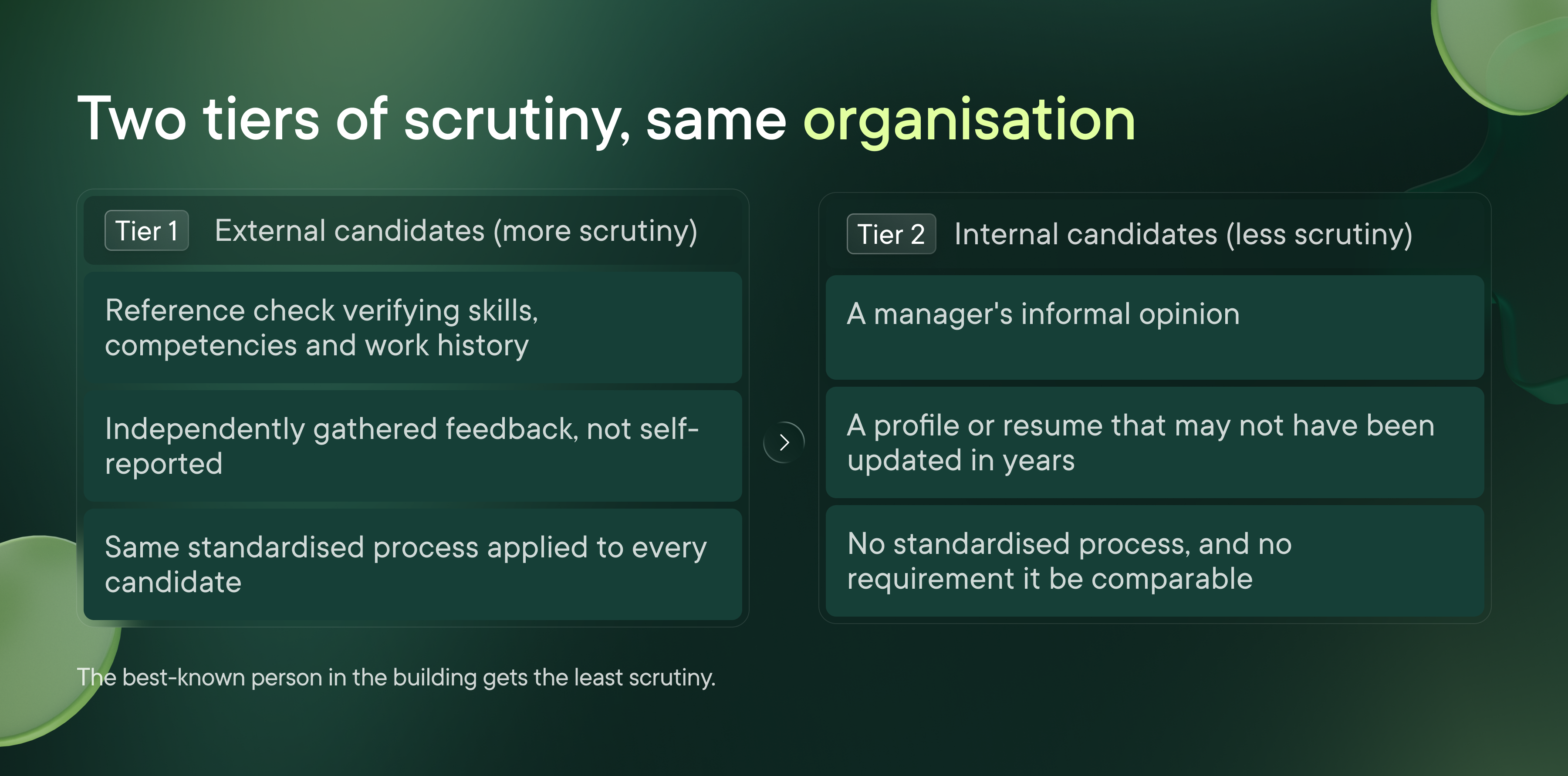
An existing employee being considered for a bigger or different internal role usually gets none of that rigour. What decides whether they move is a manager's informal opinion, a profile that hasn't been updated in years, or in plenty of cases nothing more structured than "we think they'd be good at it." Employee redeployment decisions are frequently being made on weaker evidence than a hiring decision for someone the organisation has never met. The honest reason an internal candidate gets skipped for a stretch role is rarely written down anywhere, because nobody thought to ask the question in the first place.
Internal talent marketplace platforms exist precisely to solve this. A smarter, AI-driven layer matches employees to open roles by skills and interest rather than whoever happens to be in a manager's line of sight, which is a genuine improvement over relying on tribal knowledge alone.
What it doesn't fix is what the matching engine is actually matching against. Most of these platforms run on self-reported skills profiles, a manager's periodic rating, or whatever got typed into a performance review months ago: the same unverified, inconsistent, siloed inputs the internal mobility problem started with. Feed a good algorithm thin or unreliable data and it will still return a confident-looking recommendation. It simply won't be a trustworthy one. Worse, a polished interface makes thin data look authoritative in a way a spreadsheet full of guesses never could, inviting exactly the confidence its input never earned.
Applying the same rigour to internal candidates that already applies to external ones means three things in practice:
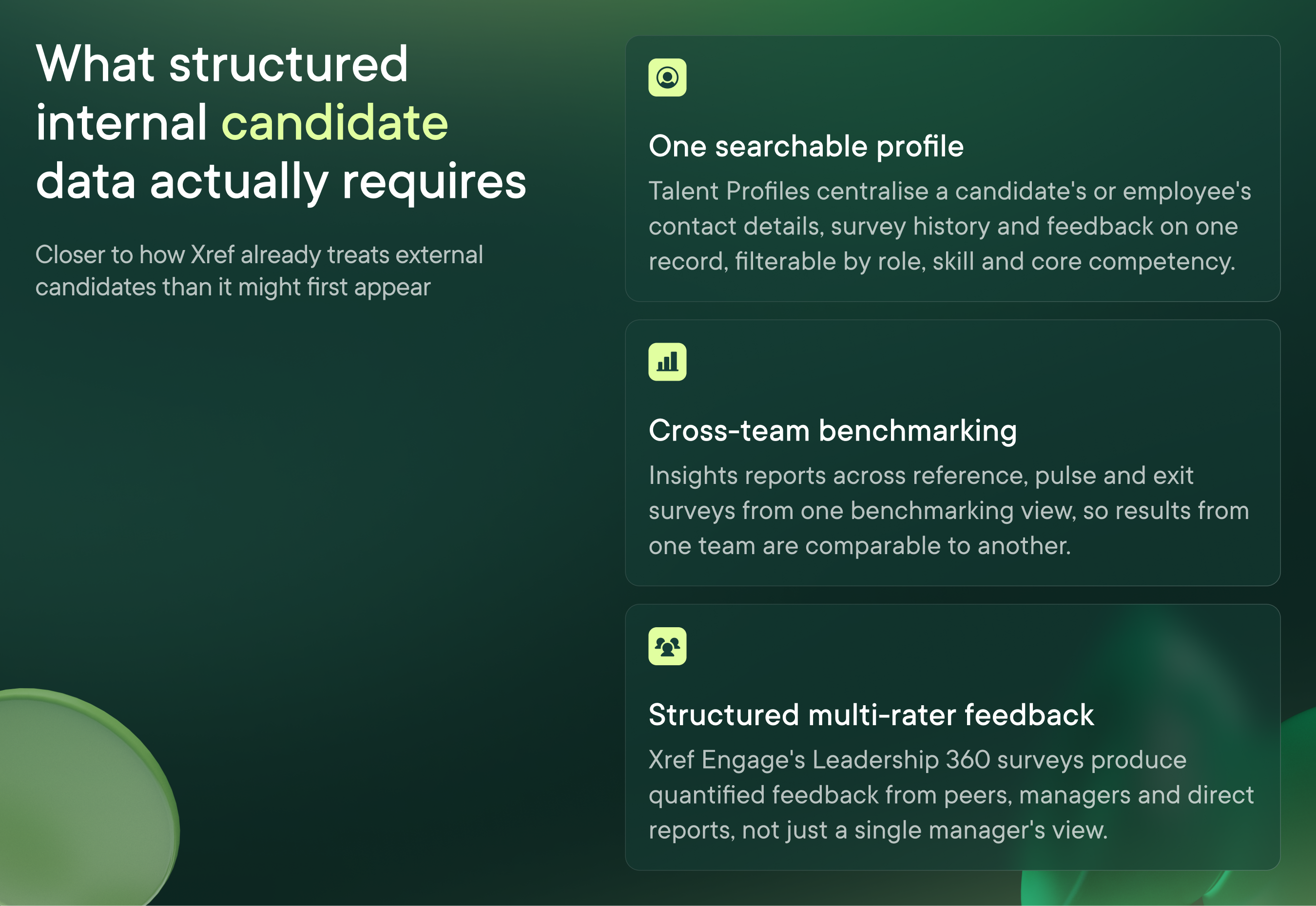
This is closer to how Xref already treats external candidates than it might first appear. Talent Profiles store a candidate's or employee's contact details, survey history and feedback on one searchable record, filterable by role, skill and core competency rather than scattered across separate documents. Insights reports across reference, pulse and exit surveys from a single benchmarking view, so a result from one team is comparable to a result from another instead of sitting in isolation. And Xref Engage's Leadership 360 surveys already produce quantified, multi-rater feedback from peers, managers and direct reports, which is the kind of structured input most organisations currently reserve for people already in leadership roles rather than the employees being considered for them.
None of that requires new technology, only a decision that an internal candidate's data deserves the same structure an external one gets by default. A manager's judgement doesn't disappear from the process either way; it just becomes one input instead of the only one, the way a reference check backs up an interview rather than replacing it.
An internal mobility strategy that starts anywhere except the data is optimising the wrong layer. Three changes make the difference, and none of them require waiting on a marketplace tool to catch up first:
The internal mobility rate Gartner is tracking won't move because a matching algorithm gets smarter. Skip that measurement long enough and the best-known person in the building eventually becomes someone else's stranger, finally verified properly during someone else's hiring process instead of yours.
Book a demo to see how Xref applies that same structured, comparable feedback to the people you already employ, not just the ones you're trying to hire.
Uncover data-driven, actionable insights with automated reference, pulse and exit surveys.