



Human Resources
—
8
min read


Give your people a voice with a tailored Xref Engage survey.
Increase retention and reduce turnover with quick employee feedback from an Xref Pulse Survey.
Nearly seven in ten employers now say they hire on skills rather than degrees. According to Harvard research, fewer than one in every 700 new hires actually secured their job because of that policy shift.
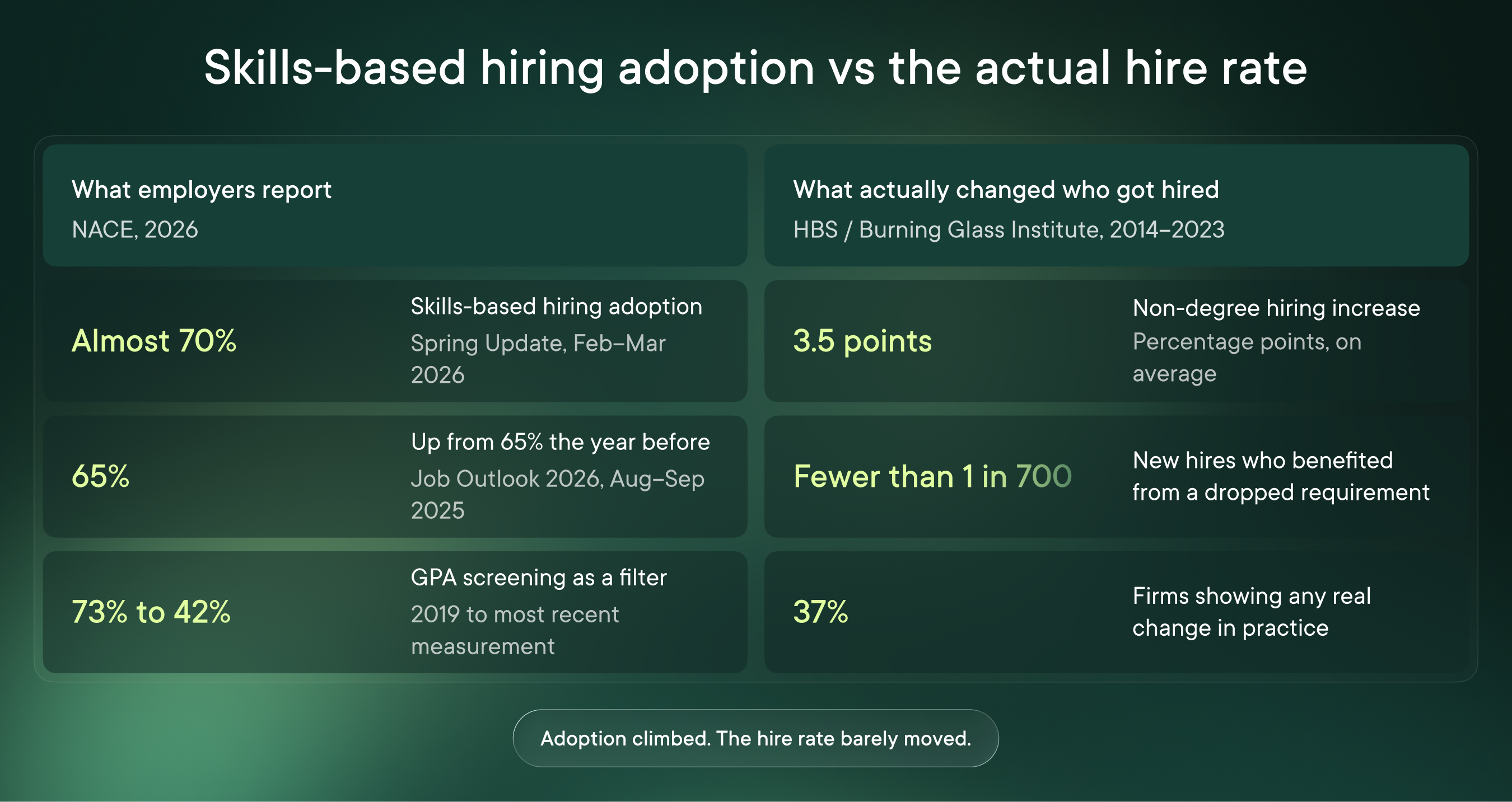
The Spring Update of NACE's Job Outlook 2026 report, an employer survey conducted between mid-February and mid-March 2026 across 185 organisations, puts skills-based hiring adoption at almost 70% . That figure is up from 65% a year earlier and has risen with every survey wave. Employers are describing a significant shift in how they screen candidates, and the survey numbers back it up.
A Harvard Business School and Burning Glass Institute analysis of more than 11,000 US job postings between 2014 and 2023 tells a different story about what that shift has achieved: removing the stated degree requirement from a job advertisement barely altered who got hired. Non-degree hiring rose by an average of 3.5 percentage points across the organisations studied, with fewer than one in 700 new hires benefiting overall. For any organisation evaluating whether its skills-based policy is accomplishing more than updating job copy, that disparity requires careful consideration before the next hiring cycle begins.
GPA screening used to be the default initial filter, but employers are stepping away from it rapidly. NACE's original Job Outlook 2026 report, fielded across August and September 2025 and published in January 2026, found 70% of employers using skills-based hiring, with 71% applying the approach at least half the time. The Spring Update held that adoption figure steady at close to 70%, while the underlying filters continued to shift: GPA screening, used by 73% of employers in 2019, sat at 42% in NACE's most recent measurement.
What has not dropped is what employers evaluate when interviewing a candidate. Most employers (73% of non-screeners and 67% of screeners) state they weigh demonstrated competency proficiency directly in the hiring decision, regardless of whether a GPA requirement remains on the checklist. A GPA cut off was always a proxy for proof of competence. Employers still require that proof; they have simply changed where they look for it.
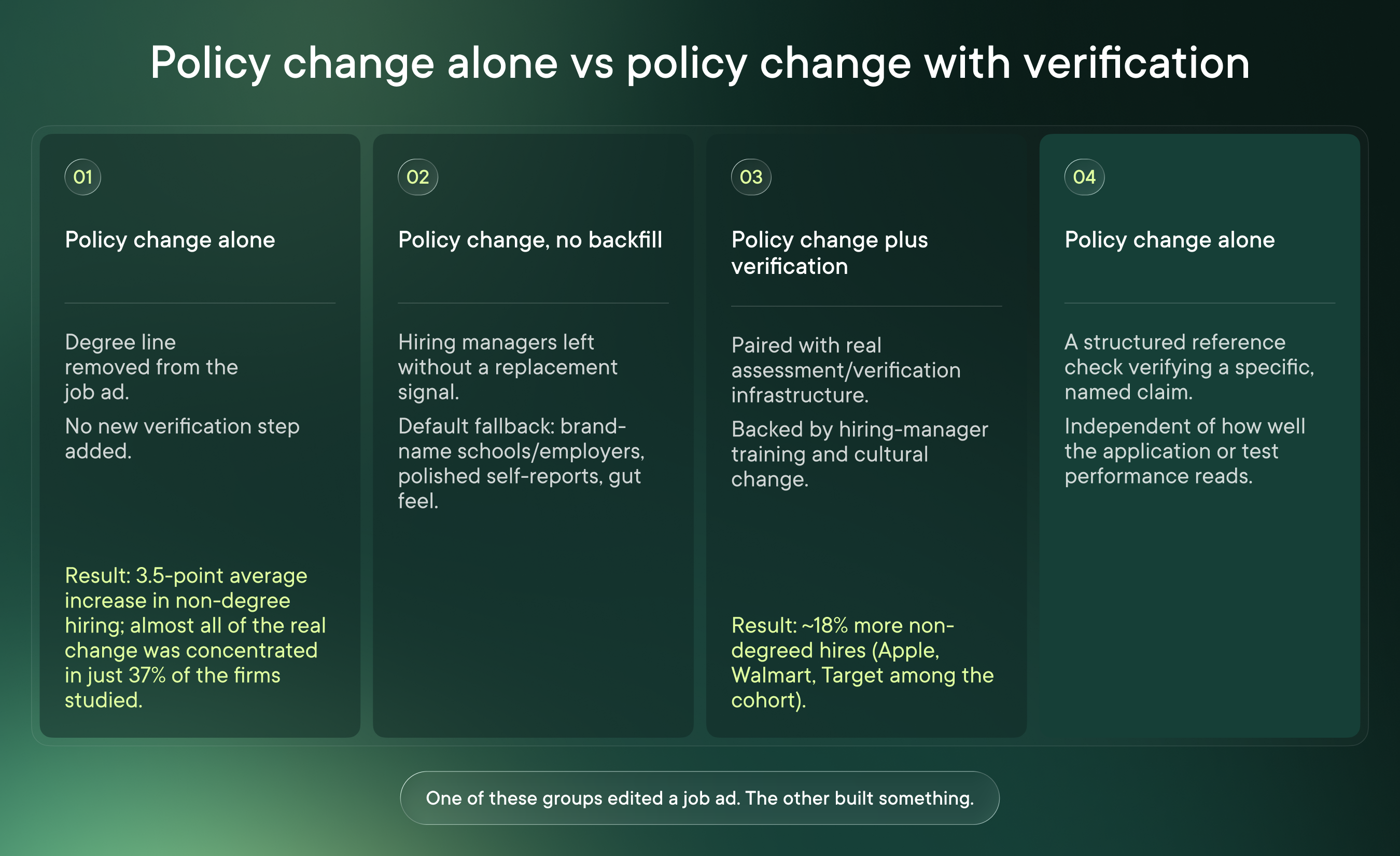
Set that adoption curve alongside Joseph Fuller's Harvard Business School and Burning Glass Institute analysis, published in February 2025, which stands as a thorough public accounting of what occurs when a degree requirement is removed from a job advertisement. Across more than 11,000 postings and nearly a decade of hiring data, removing the requirement changed very little about who was appointed: non-degree hiring increased by 3.5 percentage points on average, and only 37% of the firms studied demonstrated meaningful change in practice. This research predates 2026's accelerating adoption statistics by more than a year, and subsequent data has not contradicted its findings. Organisations are scaling the policy far faster than evidence confirms its effectiveness.
The underlying mechanism is straightforward. A degree requirement, despite its flaws as a filter, functioned as a shortcut for trust: a method for a hiring manager to evaluate an unfamiliar candidate quickly. Removing that requirement leaves a vacuum in the screening process.
Without a replacement, screening defaults to whatever proxy remains available: a prominent university or former employer, a polished self-reported skills list, or personal intuition. A hiring manager under time constraints, meeting a candidate for thirty minutes, still needs to make a decision. If the degree requirement is removed without providing an alternative verification mechanism, the decision relies on whichever remaining signal is fastest to evaluate. Those fallback signals are identical to the ones structured reference checks were designed to replace with verifiable data.
Fuller's research identifies a specific group of organisations that achieved different results: Apple, Walmart, and Target are highlighted as "degree reset leaders," a cohort that hired roughly 18% more non-degreed workers than the broader sample. These organisations implemented structured assessment and verification infrastructure, paired with hiring-manager training and cultural adjustments to support the process. Fuller noted: "Simply dropping stated requirements seldom opens jobs to those who don't have a college degree." The leading organisations addressed that gap by building dedicated verification systems.
Updating a job description requires minimal effort. Establishing verification infrastructure requires hiring-manager time, dedicated training resources, and systems designed to evaluate candidate capabilities systematically. While select market leaders invested in those structures, many organisations adopting skills-based hiring policies in 2026 have yet to build them.
A skills test evaluates a single performance, on a specific day, under monitored conditions. While this offers an improvement over unverified claims, it presents distinct limitations. Test performance can be coached or, in certain contexts, completed with external assistance. Passing an assessment confirms a candidate can perform under direct evaluation, which is a narrower claim than demonstrating long-term job competence. A hiring manager relying solely on an isolated test result is trusting an unconfirmed data point. It provides no indication of consistent performance in day-to-day operational environments.
Verifying a claimed skill effectively requires input from individuals who observed the candidate's work directly. A named former manager or colleague, asked specific questions regarding candidate performance, provides a perspective that the candidate cannot directly alter. This verification layer remains missing from many skills-based hiring programs.
Xref's Survey Builder addresses this requirement by tailoring verification to specific role requirements. Its recommendation engine suggests questions aligned with the competencies an employer prioritises, utilising targeted persona presets for professional, academic, volunteer, and departing-employee referees. Results are delivered as quantified feedback mapped against the verified competencies, providing structured data for candidate comparison. Additionally, the system continuously monitors data touchpoints across the referencing process to flag unusual activity, ensuring candidate submissions are authentic.
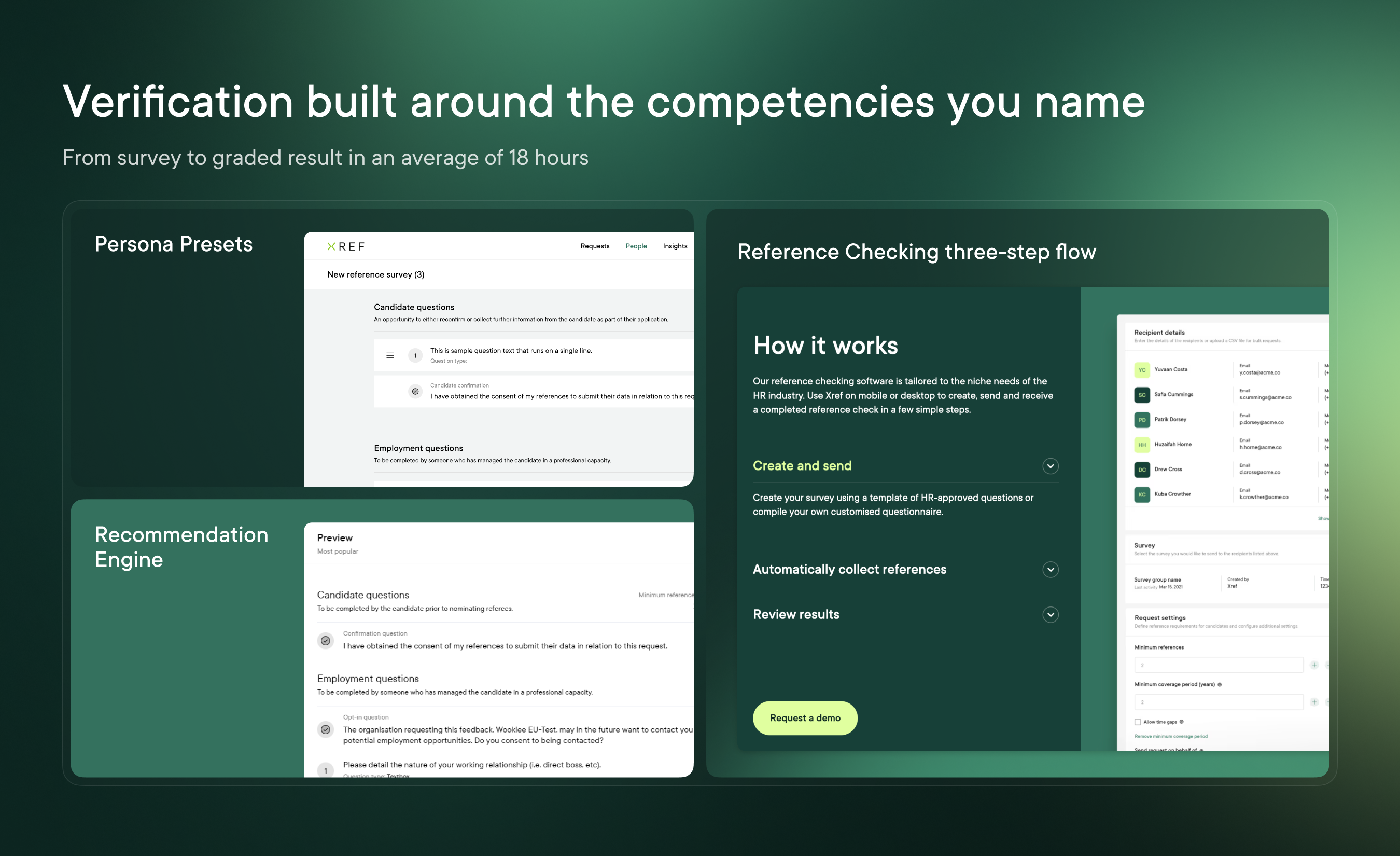
This verification layer can be implemented without creating hiring bottlenecks. Reference requests can be generated in 30 seconds from standard templates or custom surveys, responses arrive in an average of 18 hours , and bulk functionality supports up to 100 candidates simultaneously. Centralised Talent Profiles maintain this verified competency data in a searchable repository by role and skill, ensuring verified candidate insights remain accessible for future hiring requirements.
Future survey cycles will likely show skills-based hiring adoption continuing to rise. However, the critical metric to evaluate will be whether the actual hiring rates for non-degreed candidates change, indicating whether organisations have established robust verification systems or simply shortened their job advertisements.
Xref's reference checking platform provides the infrastructure required to verify candidate capabilities at scale. Contact our team to incorporate structured verification into your organisation's skills-based hiring strategy.
Uncover data-driven, actionable insights with automated reference, pulse and exit surveys.