



Human Resources
—
7
min read


Give your people a voice with a tailored Xref Engage survey.
Increase retention and reduce turnover with quick employee feedback from an Xref Pulse Survey.
A resume used to tell you something about the person who wrote it. Now, according to the people actually reading them for a living, it mostly tells you which AI tool they used.
Michael Page senior managing director David George told the ABC in May 2026 that the widespread use of AI in job applications was making it "incredibly difficult" for employers to identify good candidates. "What we're finding with AI when it comes to job applications is people are applying en masse, and all CVs look the same," he said. "Trying to really work out what a good CV is versus a bad CV, that's almost irrelevant now." That is not a complaint about how many AI-generated resumes are landing in a recruiter's inbox. It is a complaint about what those resumes can actually tell you, and it is the harder of the two problems, because most hiring teams are trying to solve it with the tool that caused it: more screening, done faster.
Brisbane recruitment consultant Meqa Smith described the practical response already under way: writing more intentional job descriptions, adding stricter application guidelines, and building video-based questions into the early stages of a process, all aimed at giving legitimate, differentiated candidates a way to stand out before a human opens a CV. It is a reasonable response to a real problem. University of Queensland data science professor Gianluca Demartini named the mechanism behind it plainly: AI writing tools cause candidates to lose "this unique flavour and the personality of the applicant because all of these tools will generate a very similar type of CV."When the input has been polished by the same handful of models toward the same conventions of what a strong CV sounds like, the differences that used to separate a great candidate from an adequate one: word choice, structure, the small tells of how someone actually thinks about their own experience, get sanded off in the process.
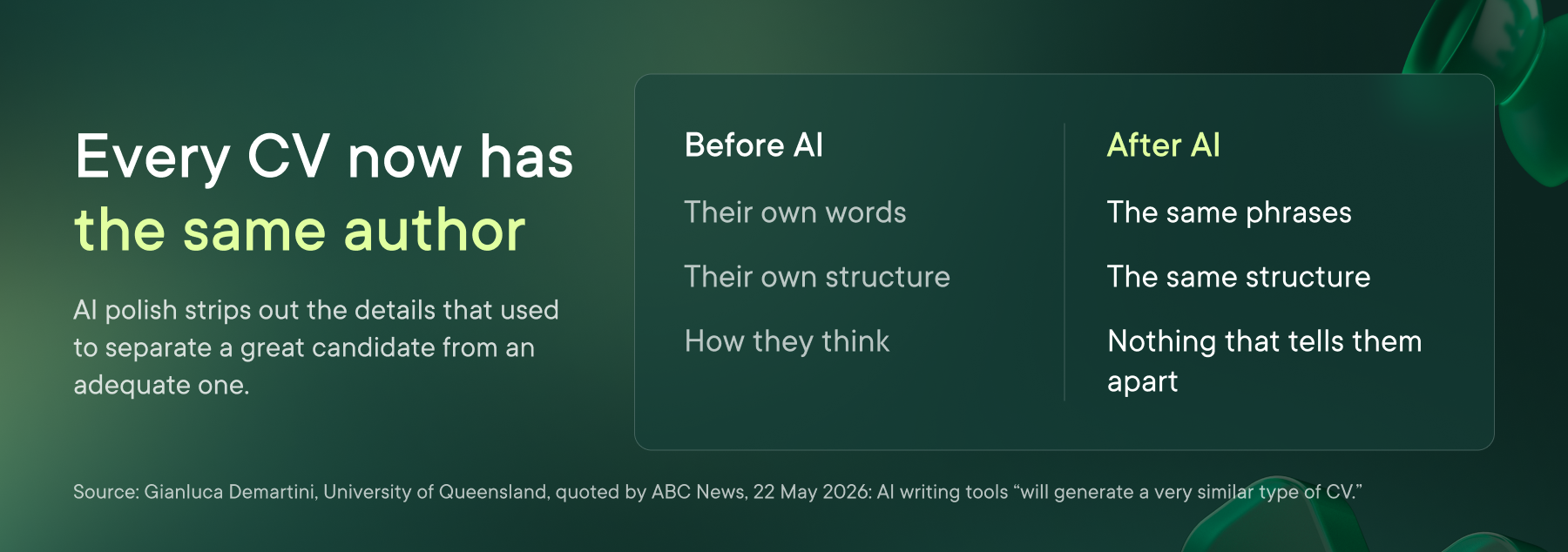
These accounts do not reflect an overseas trend being imported. They are on the record from an Australian market leader, describing an Australian hiring problem, in an industry Xref's own customers are hiring into right now.
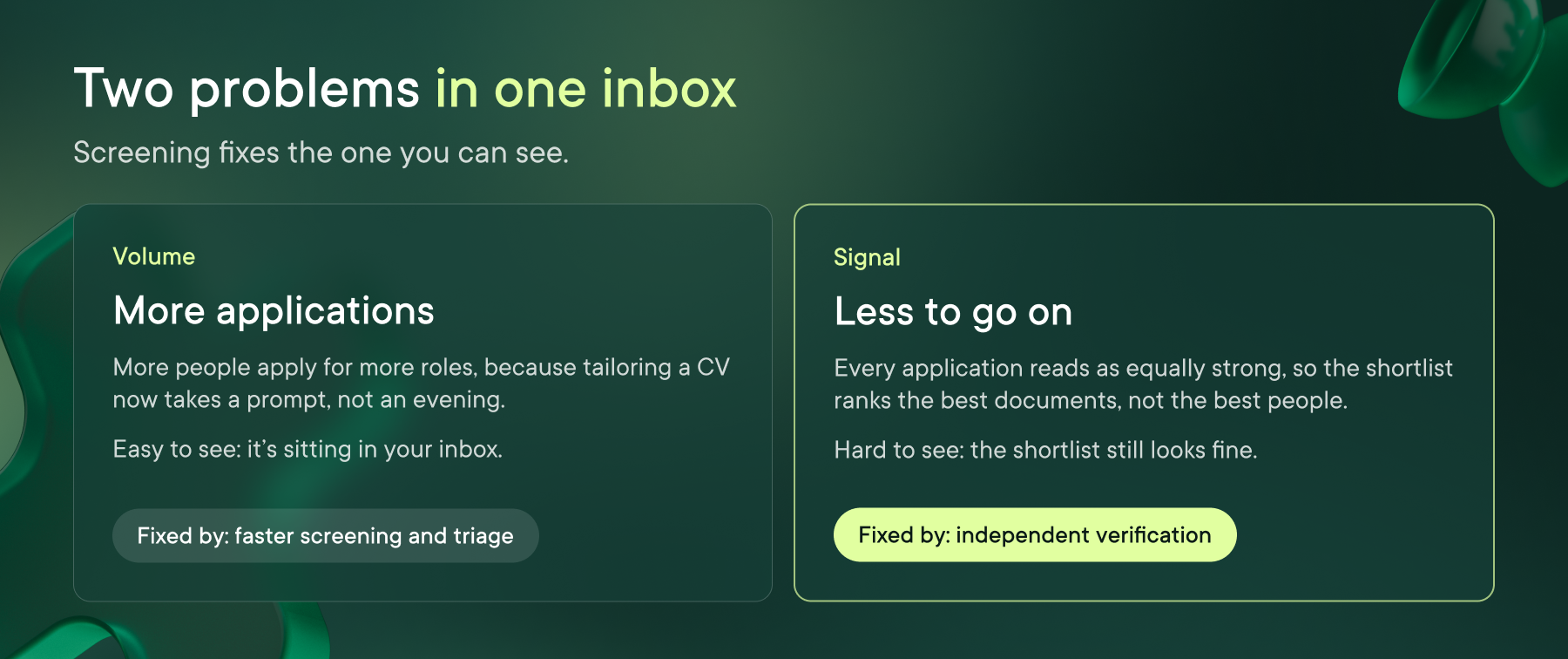
George's description holds two separate problems, and it is worth pulling them apart. The first is volume. When tailoring a CV to a new job ad takes a prompt rather than an evening, applying for one more role costs a candidate almost nothing, so more people apply for more roles. The second is signal. Every one of those applications now reads as if the same careful, competent author wrote it, because in a meaningful sense the same author did.
Volume gets most of the attention because it is the problem recruiters can see, sitting in an inbox. It is also the easier one to solve. More screening capacity, tighter knockout questions and better triage will all bring a long list down to a manageable shortlist. Not one of them can tell you whether the person at the top of that shortlist can actually do what their CV says.
Signal is the harder problem, and it is the one most hiring processes are quietly losing. A shortlist built from documents that all sound equally strong is not a shortlist of the strongest candidates. It is a shortlist of the strongest documents, and a screening process built to handle volume does not touch that problem at all.
An AI tool writing a CV and an AI tool screening that CV are optimising against the same axis: does this text read like a strong candidate. That is a contest of language quality, not a contest of truth, and running it twice, once to generate the document and once to judge it, does not cancel the distortion. It compounds it. Demartini's warning about bias risk points at exactly this: when every CV has been smoothed toward the same AI-generated register, a screening model rewarding that register can systematically discount candidates whose CVs, for reasons of language, background, or writing style, do not match the pattern it has learned to favour. Screening harder does not fix the sameness. It rewards whoever sounded most like everyone else.
There is a practical line worth drawing here. Drafting job ads, scheduling interviews and answering routine candidate questions are all sensible jobs to hand to automation, because nobody’s hiring decision rides on the wording of a calendar invite. Deciding whether an application represents a real, well-matched candidate is a different kind of job. It is a judgement about whether a set of claims is true, and a model trained to recognise convincing writing is answering a different question.
At this point, "screen faster" and "verify independently" become two completely separate strategies, and only one scales as the quality of AI writing advances.
Structured reference checks rely on a named former manager confirming or contradicting specific, concrete claims about past performance. No amount of AI polish can pre-empt a question like that, because it was never a question about the document in the first place. A referee does not grade prose; they state whether the claim holds up.
This stage of the process does not slow down as application volume rises, addressing the volume challenge directly. Xref's reference checks can be created in as little as 30 seconds from a template or custom survey, with results returned in an average of 18 hours, ensuring verification does not become a bottleneck at higher application volumes. Results return as quantified, graphed scores against specific skills and competencies rather than a general impression. Xref's unusual-activity detection monitors multiple data touchpoints through the process itself, catching the kind of manipulation a resume, AI-written or not, has no equivalent defence against.
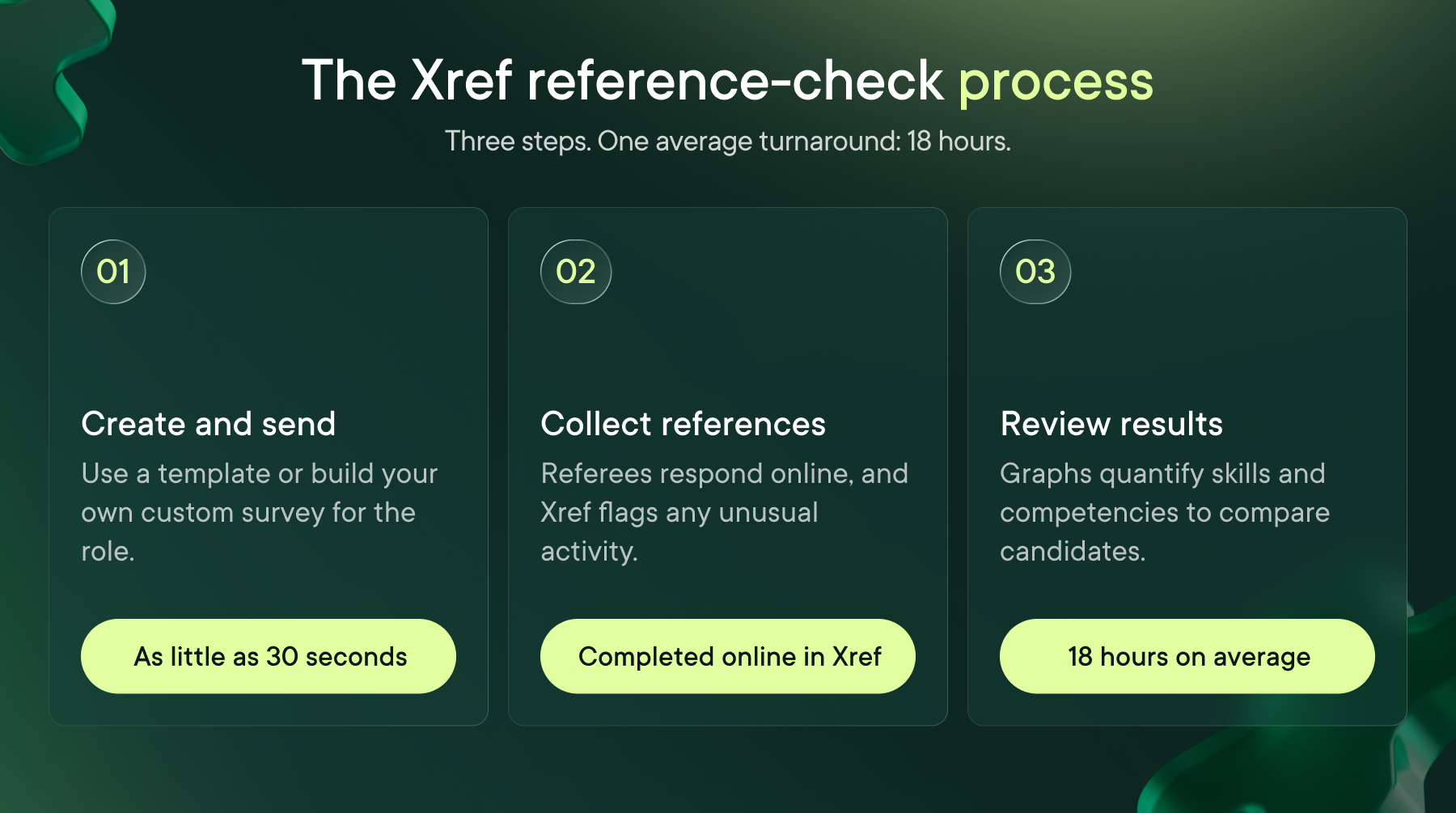
The resume does not need to be flawless for this process to succeed; it relies on the honesty of the referee.
Regardless of how it was generated, a resume presents the candidate's preferred narrative, polished by available software to maximise impact. A verified reference carries no such spin. It comes from someone who was never trying to make the CV sound good, because they did not write it. Ask a recruiter today what a resume actually tells them, and increasingly, per David George, the answer is close to just the name of the AI tool used to write it. Ask a former manager what a candidate actually did, and the answer remains consistent regardless of the tools used to draft the document.
If an organisation is attempting to resolve a signal issue simply by screening faster, it is worth evaluating what that speed truly optimises. Xref's reference checking addresses the part of hiring that speed alone cannot resolve. Consult with Xref's team to integrate structured verification into your process, tailored to your current hiring volume.
When every CV looks impeccably polished, relying on self-reported applications leaves talent teams vulnerable to costly mis-hires.
Xref replaces the guesswork with automated, data-driven verification. By collecting structured, multi-source reference checks from past managers, the platform delivers an objective view of a candidate's actual capability, soft skills, and work ethic. Built-in fraud detection flags suspicious referee activity, while standardised questionnaires ensure every applicant is evaluated on equal footing without bias.
With turnaround times averaging just 18 hours, talent teams get the verified evidence needed to validate real-world performance, speed up time-to-hire, and make confident decisions to avoid bad hires and retain their best.
Uncover data-driven, actionable insights with automated reference, pulse and exit surveys.