



Human Resources
—
7
min read

Give your people a voice with a tailored Xref Engage survey.
Increase retention and reduce turnover with quick employee feedback from an Xref Pulse Survey.
If your reference checking process is an afterthought, a box you tick in the final days before an offer, you are not just behind the times. You are exposed.
The hiring landscape has shifted in ways that most organisations have not fully reckoned with. AI tools have made it trivially easy for candidates to produce polished, persuasive applications at scale. A cover letter that once took an hour to craft now takes 30 seconds. A skills summary can be generated, tailored, and keyword-optimised before a recruiter has finished their morning coffee. Application volumes are rising sharply, and the surface quality of those applications is no longer a reliable indicator of the person behind them.
In this environment, the reference check is not a formality. It is one of the last genuinely reliable signals in the hiring process. And for organisations without the right tools and process in place, fake and fraudulent references are a problem they are almost certainly not equipped to detect.
To be clear: AI tools are not the enemy of good hiring. They are useful, and candidates using them are not automatically dishonest. The problem is structural. When every resume looks polished, the traditional signals recruiters rely on to identify strong candidates, writing quality, presentation, attention to detail, become meaningless as differentiators. Everyone looks good. The volume is overwhelming. And the pressure to move quickly means verification gets pushed to the end of the process, or skipped entirely.
According to Xref's Recruitment Risk Index, 75% of HR professionals have found a lie on a resume. Separate Xref platform data, drawn from more than 100 million reference check questions across 195 countries, shows that around 21% of candidates are flagged during the reference checking process. These are not edge cases. They are the baseline reality of modern hiring, and they are getting harder to catch as AI makes fabrication easier and more convincing.
The candidates who are misrepresenting themselves are not always doing so dramatically. More often, it is small adjustments: inflated job titles, extended employment dates, responsibilities that were observed rather than held. Individually, these details might seem minor. Cumulatively, they can paint a picture of a candidate that is meaningfully different from the person who will actually show up on day one.
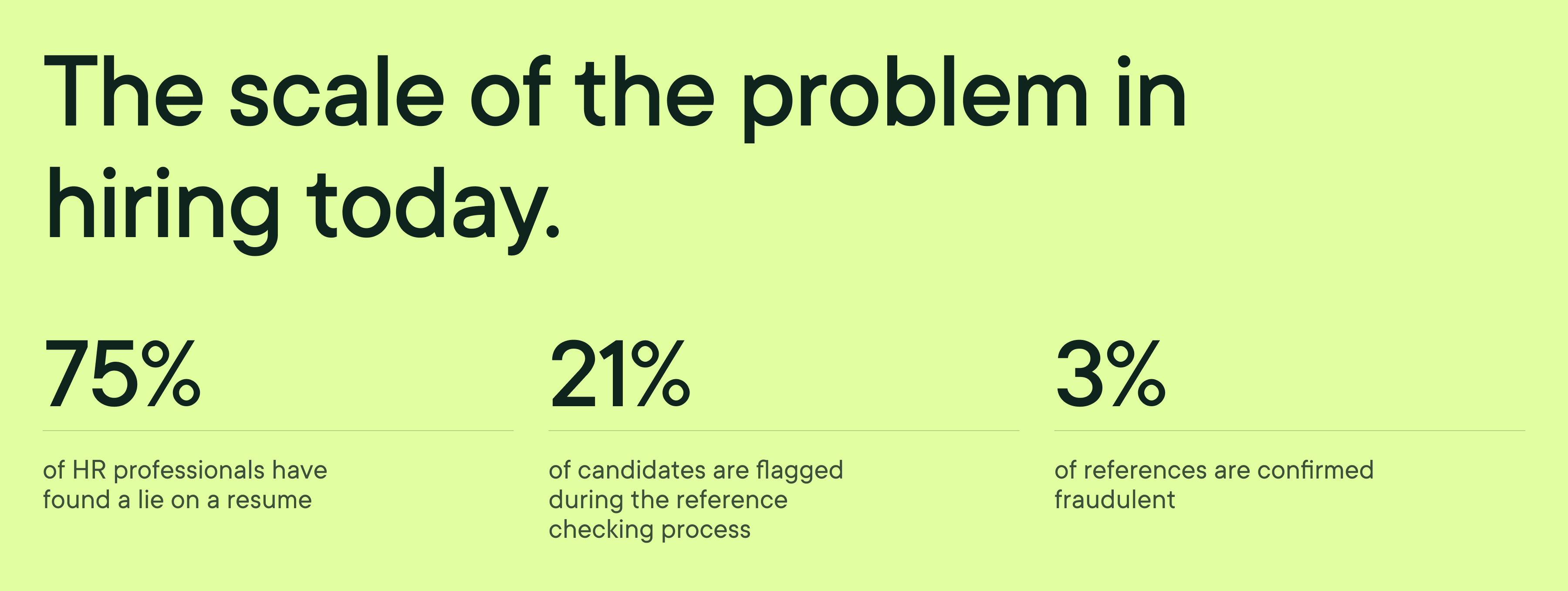
Beyond innocent exaggeration, outright reference fraud is a genuine and documented problem. Xref data confirms that 3% of references are fraudulent, meaning the person completing the reference is not who they claim to be. In practice, this means candidates submitting references from friends posing as managers, from fabricated email addresses, or in some cases completing the reference themselves.
For organisations relying on phone-based or informal reference processes, this kind of fraud is almost impossible to detect. A hiring manager calling a mobile number provided by the candidate has no reliable way to verify that the person on the other end of the line is who they say they are. There is no audit trail. There is no data. There is just a conversation that may or may not be what it appears.
This is not a hypothetical risk. Xref's platform has flagged thousands of cases of suspicious activity, including instances where the IP address used to complete a reference matched the candidate's own device, where references were completed within seconds of each other suggesting a single author, and where the language patterns across multiple references were near-identical. None of these red flags are visible to a recruiter conducting a phone-based reference.
Most organisations know reference checking matters. The gap is not awareness. It is process.
The most common failure modes are:
Each of these failures is solvable. But solving them requires a structured, technology-enabled approach. Ad hoc reference checking, regardless of how experienced the hiring manager, cannot consistently deliver the rigour that modern hiring demands.
The same AI capabilities that are complicating the hiring landscape are also making reference checking more powerful, when used correctly.
Platforms like Xref do not simply collect reference responses. They analyse them. Natural language processing identifies sentiment patterns in open-ended responses, surfacing signals that a human reviewer might miss. A referee who writes at length, who uses specific examples and positive language, is expressing something meaningfully different from one who gives brief, generic answers. Both might look acceptable on the surface. Only one is a genuine endorsement.
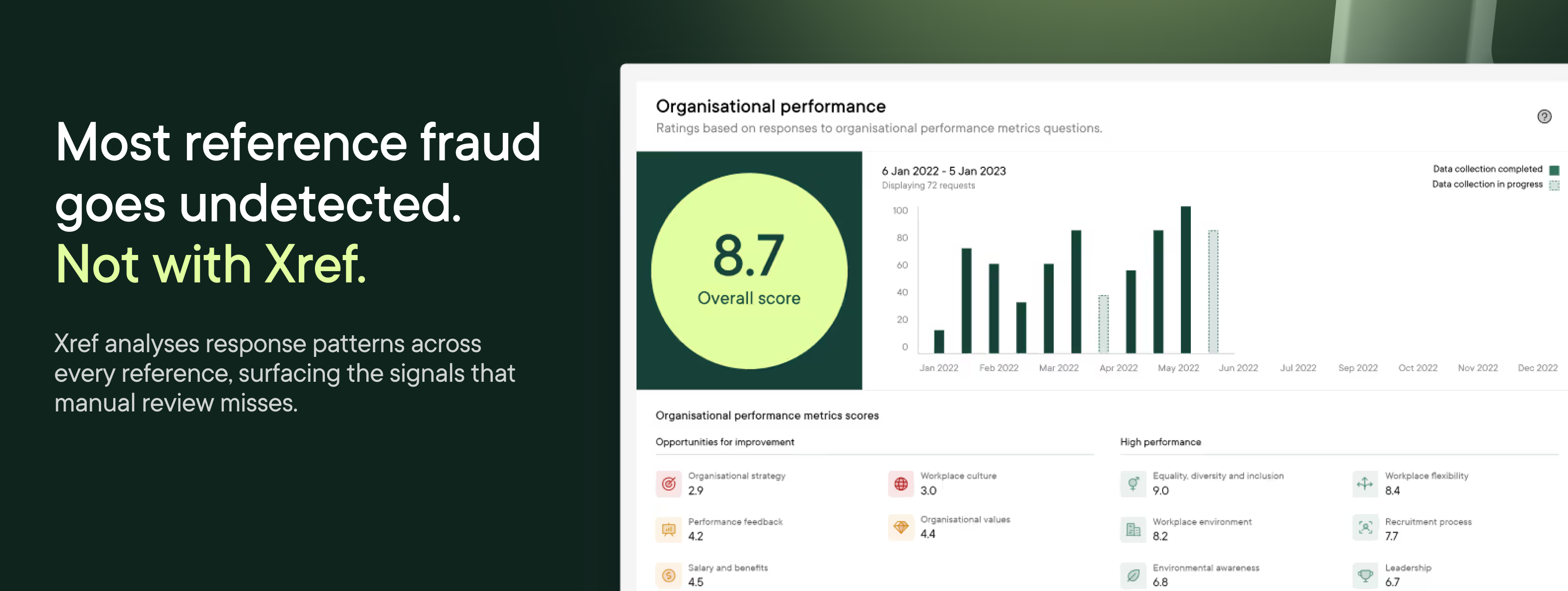
Xref's fraud detection monitors multiple data points throughout the reference process in real time: the location and device used to access the platform, the timing of responses, the consistency of language across referees, and the match between candidate-supplied information and what referees confirm. When something does not add up, the platform flags it before a hiring decision is made, not after.
This is the kind of rigour that is simply not available to organisations running reference checks manually. And in a market where fraudulent submissions are rising and stakes are high, the difference between having that capability and not having it is a genuine hiring risk.
One of the most important shifts in modern hiring practice is the move to verify candidates earlier in the process, not just at the end. When verification happens only after multiple interview rounds, any problems that surface come too late to avoid significant wasted time and cost. The candidate has met the team. The hiring manager is invested. Withdrawing from the process at that stage is genuinely disruptive.
Platforms are beginning to address this by enabling candidates to build verified career profiles proactively, before they even apply for a role. A candidate who arrives at the first touchpoint with verified references and confirmed employment history has already done something that most other candidates have not: they have provided independent evidence of their claims.
For employers, this changes the dynamic. Instead of treating verification as a final hurdle, it becomes a signal available from the very first interaction. Candidates who have invested in building a verified profile are demonstrating a level of transparency and confidence that itself carries useful information.
For high-trust industries, including aged care, childcare, healthcare, and government, this shift is particularly significant. In roles where the consequences of a bad hire extend well beyond business impact to vulnerable people and regulatory obligations, early verification is not a process improvement. It is a duty of care.
Effective reference checking in 2026 is structured, consistent, fraud-aware, and integrated into the hiring process early enough to be useful. Practically, that means:
Xref helps organisations hire with confidence by combining structured reference checking, AI-assisted fraud detection.
Ready to make verification a strength in your hiring process? Book a demo with our team to discover how.
Uncover data-driven, actionable insights with automated reference, pulse and exit surveys.