


Human Resources
—
7
min read


Give your people a voice with a tailored Xref Engage survey.
Increase retention and reduce turnover with quick employee feedback from an Xref Pulse Survey.
Teaching is mission-driven work. But even the most committed educators can only give their best when the conditions around them support it. So how are independent schools actually tracking when it comes to staff engagement, wellbeing, and the things that make people stay?
Xref Engage has been surveying independent school employees for over a decade. In the last 5 years, 47 schools across Australia participated, with an average of 3000 staff responding each year at an average response rate of 76%. Benchmarked against 30,000+ responses from across all industries in Australia and New Zealand, the data paints a nuanced picture: there is real cause for optimism, but also some persistent gaps that school leaders cannot afford to ignore.
Here is what the data is telling us.
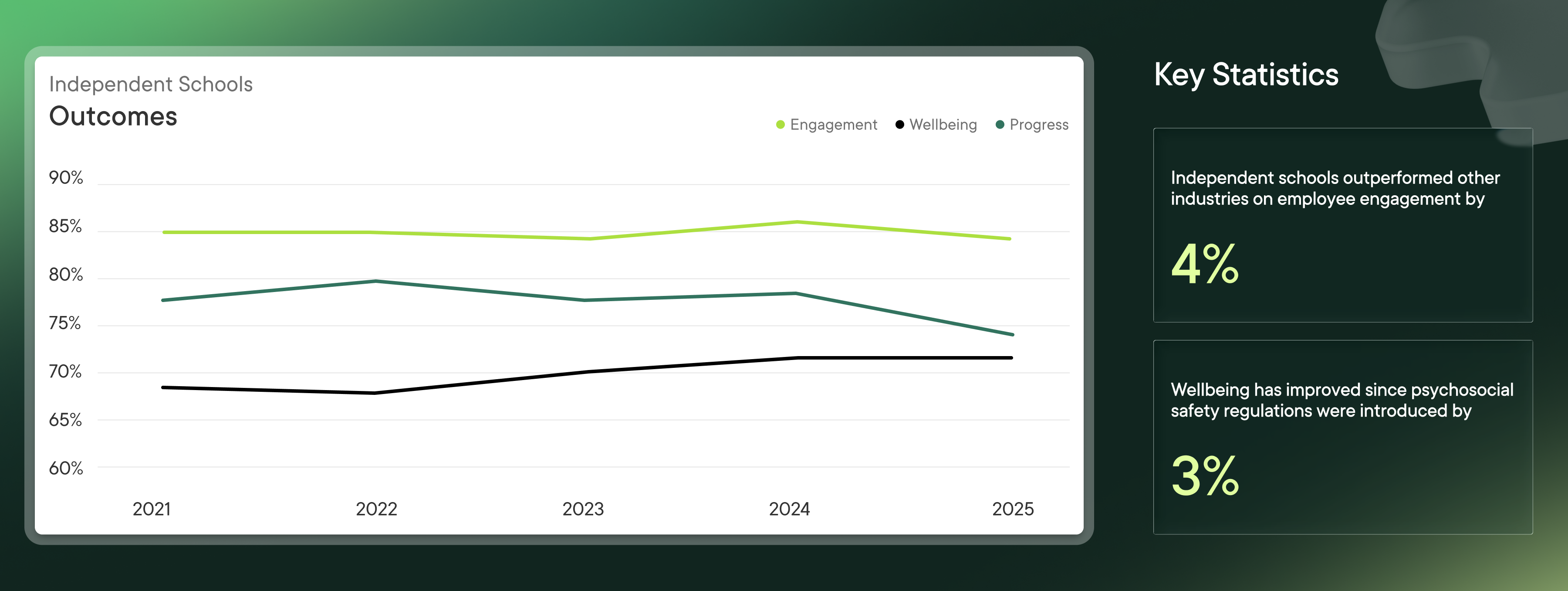
Independent schools have consistently outperformed other industries on employee engagement by 4% across the full five-year period. That is not a small margin when measured against tens of thousands of responses from every other sector.
Wellbeing has also improved, up 3% since psychosocial safety regulations were introduced in 2022, a result that mirrors broader industry trends but is worth noting given the acute workload pressures schools face (more on that below).
This sustained engagement advantage likely reflects the nature of the work itself. School staff tend to have a strong sense of purpose and connection to their community. The question for school leaders is whether the structures around them are strong enough to protect and build on that foundation.
For four consecutive years, satisfaction with pay in independent schools was in decline. The 2024 state teacher pay rises, significant in NSW and many other states, appear to have reversed that trend. School staff now report higher satisfaction with their income (+8%) and benefits (+6%) compared to the all-industry average.
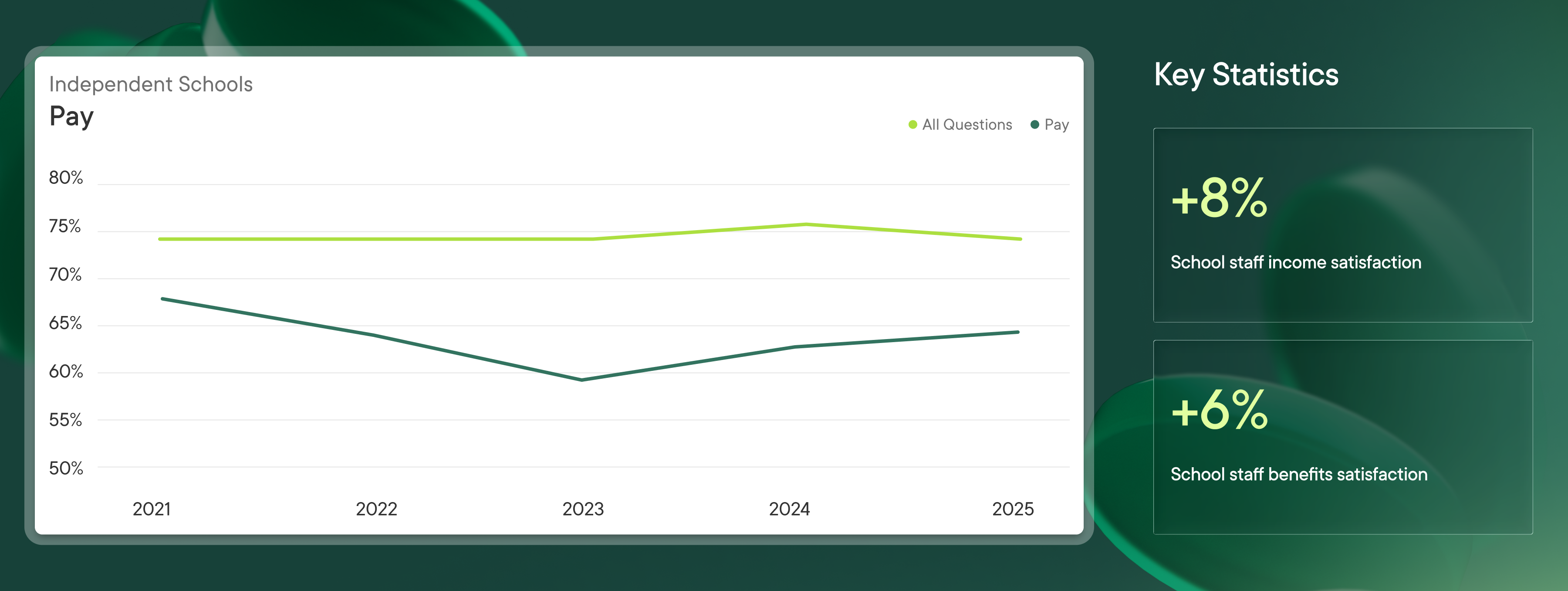
This is a meaningful shift. Pay dissatisfaction is one of the most reliable predictors of turnover intent, particularly in sectors where employees are deeply mission-driven and may have tolerated lower pay for longer than workers in other fields might. Sustained investment in competitive remuneration will be critical to holding onto this gain.
The single largest improvement over the five-year period is in perceptions of environmental responsibility, up 16% since 2021. This is a significant shift, and reflects the growing expectation among school staff, particularly younger educators, that their employer takes sustainability seriously.
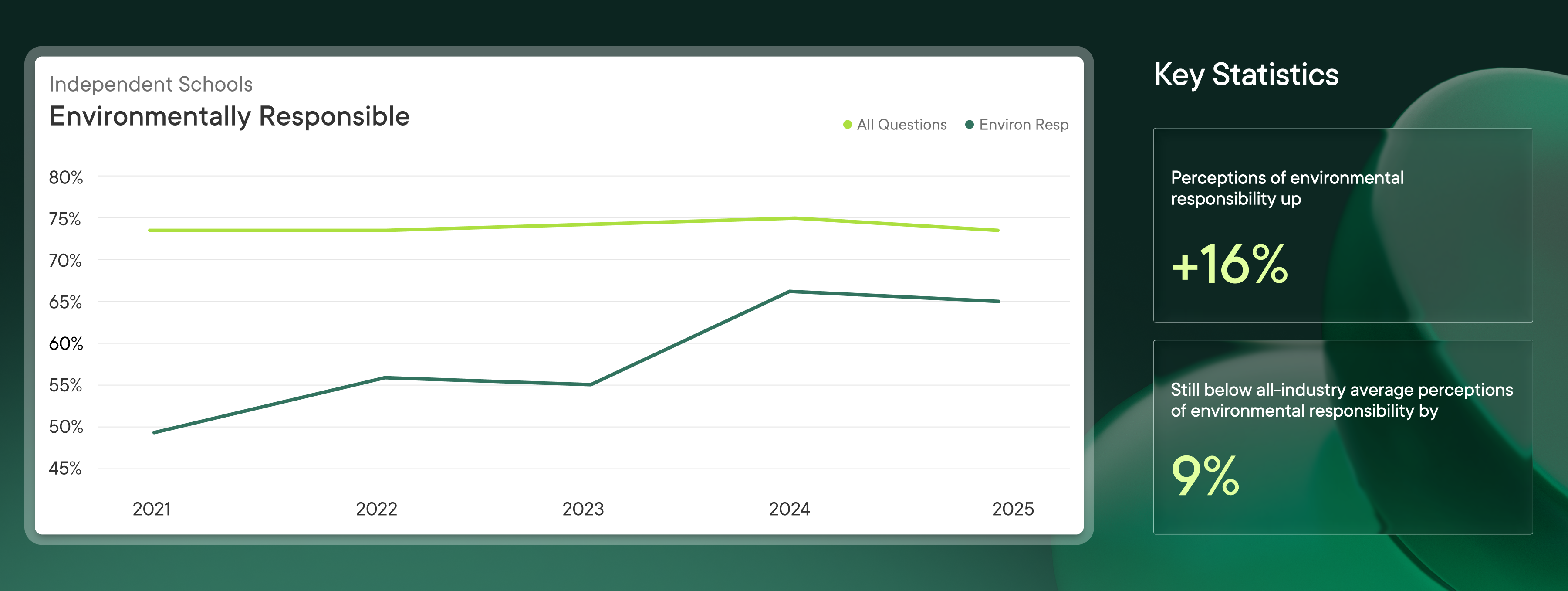
That said, independent schools are still 9% below the all-industry average on this measure, which suggests there is still meaningful ground to cover. Schools that are investing in sustainability initiatives would benefit from communicating those efforts more actively to staff, visibility matters as much as action.
This is where the data becomes more challenging. Independent schools trail other industries by 16% on flexible work arrangements, 16% on work-life balance, and 15% on out-of-hours contact boundaries. For a workforce that is already carrying above-average workload pressure, these are not abstract concerns.
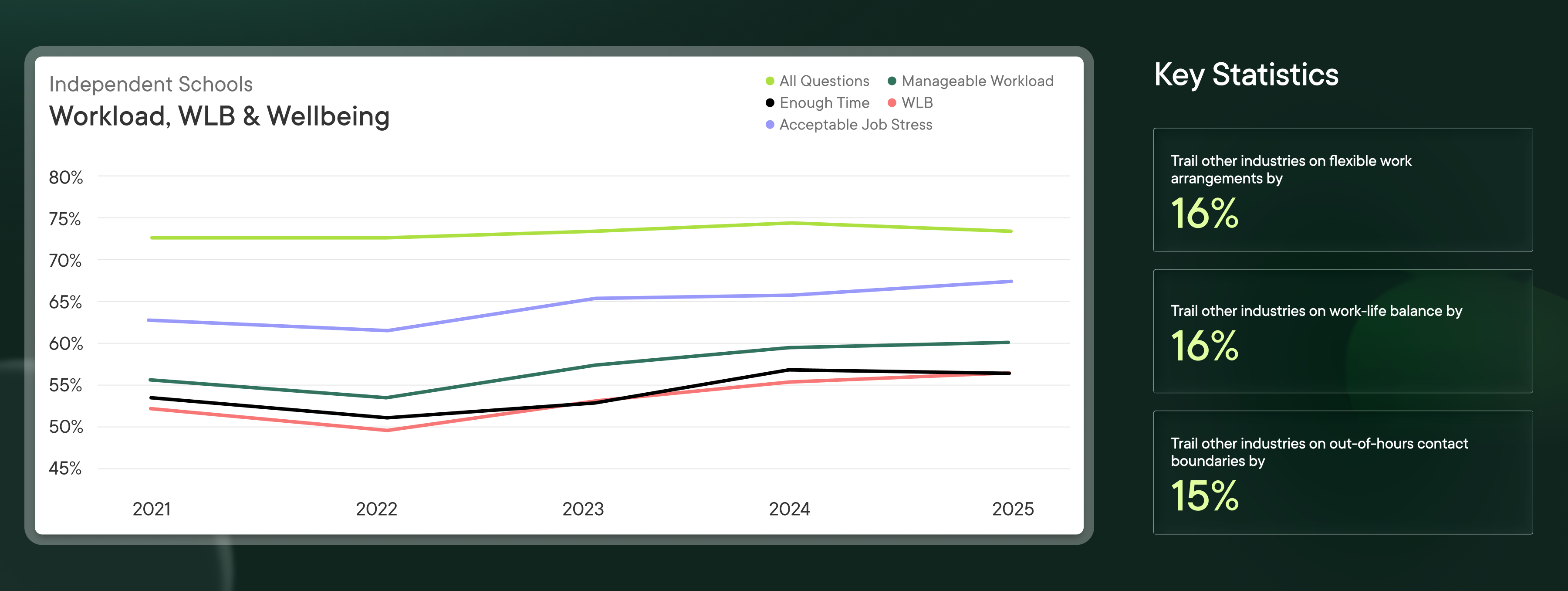
The good news is that 2025 showed the first signs of movement, with satisfaction in flexible work arrangements rising 3% after three years of stagnation. That is an early indicator worth watching, not yet a trend, but a signal that schools may be starting to respond.
The workload picture is similarly complex. Fewer school staff report having enough time to do their jobs well (-9% below other industries), a manageable workload (-7%), and a healthy work-life balance (-16%). Yet all of these measures have improved over the five-year period. Schools are moving in the right direction, but the gap with other industries remains real.
One finding that deserves particular attention from school leaders is the data on psychological safety and staff voice. Independent school employees are 7% less likely than workers in other industries to feel safe speaking up with a different opinion, and involvement in decision-making trails the all-industry average by 8%.
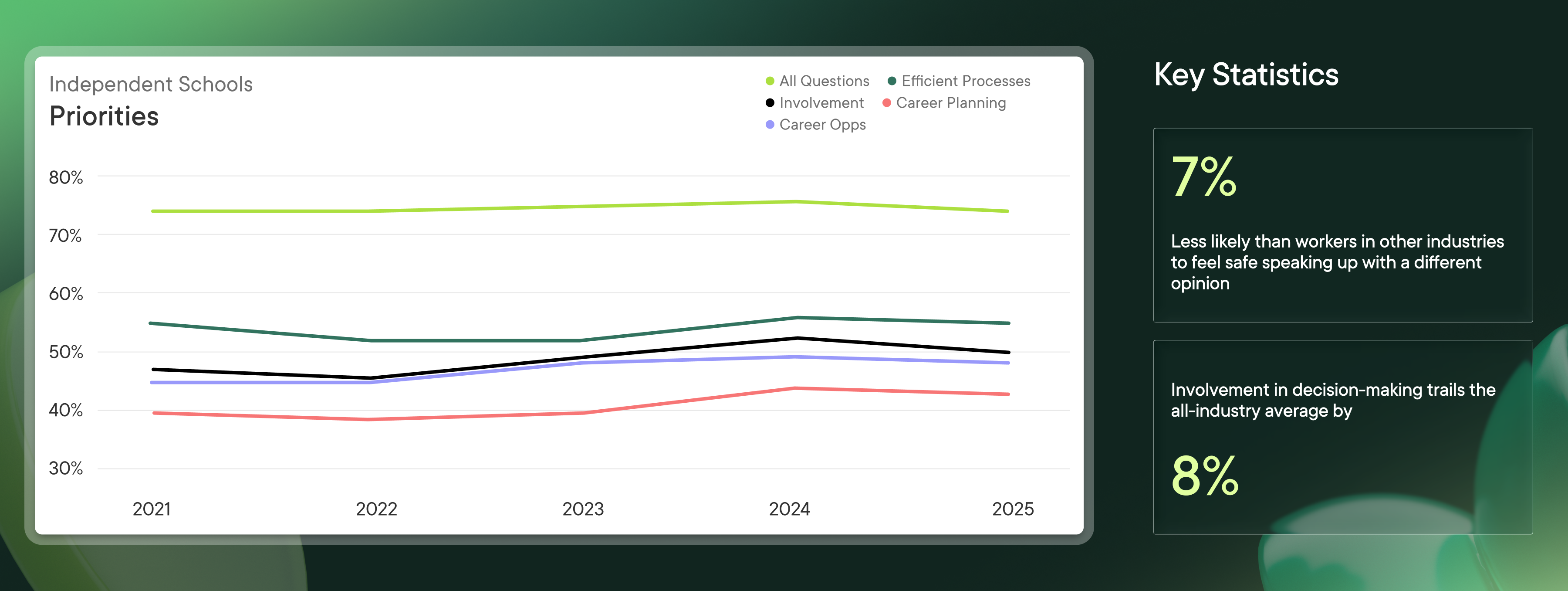
Research consistently links voice safety to both engagement and wellbeing outcomes. When staff do not feel safe to raise concerns or contribute to decisions, it erodes trust over time -- regardless of how high other engagement scores are. For schools committed to a culture of continuous improvement, creating genuine channels for staff input is not optional.
While independent schools remain 7% ahead of other industries in perceived student and parent satisfaction, perceptions of school innovation have dropped 11% since 2022. Staff do not feel their schools are keeping pace with change.
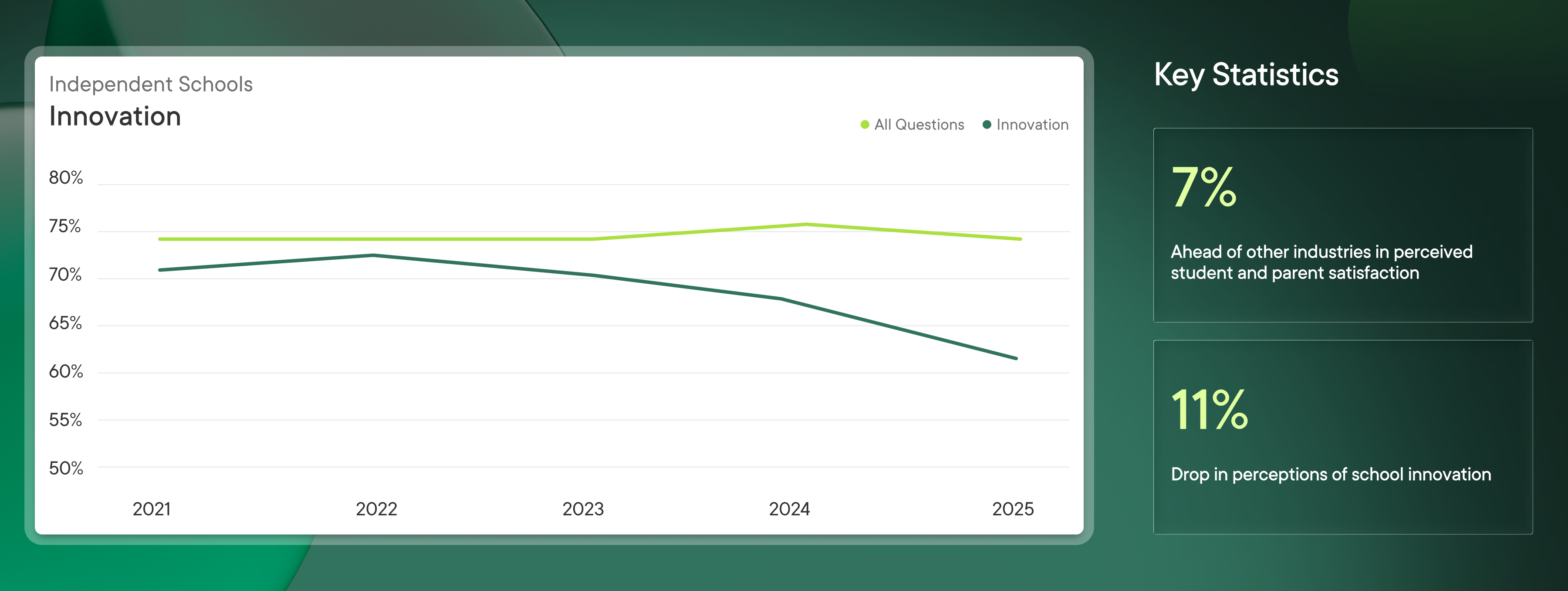
This is a finding worth sitting with. In an environment where AI, pedagogy, and student needs are evolving rapidly, a workforce that does not feel innovation is valued or supported is a risk -- both for educational outcomes and for the retention of high-performing staff who want to grow professionally.
Five years of longitudinal data gives independent school leaders something genuinely useful: not just a snapshot of how staff feel right now, but a view of where things are heading and where the gaps with the broader workforce are widest.
The data is there. The question is what will schools choose to do with it.
Xref Engage helps independent schools and other organisations run scientifically validated employee engagement surveys, benchmarked against industry data.
If you would like to understand how your school compares, get in touch with our team today.
Uncover data-driven, actionable insights with automated reference, pulse and exit surveys.