


Human Resources
—
6
min read


Give your people a voice with a tailored Xref Engage survey.
Increase retention and reduce turnover with quick employee feedback from an Xref Pulse Survey.
Most Australian organisations that rolled out enterprise AI this year followed the same script. Licences went out, an acceptable-use policy went up on the intranet, and the project was marked complete.
Employees see it differently. A Gartner survey of Australian workers released in Sydney on 17 November 2026 found that more than 27% fear AI will make their skills obsolete. While 90% of employees expected to use AI in their role say their organisation provides enterprise tools, only 54.6% report receiving formal learning opportunities. For HR, People & Culture, and L&D leaders, this creates an immediate blind spot: which skills are actually fading across your teams, and how would you catch it early? Asking the people doing the work, team by team, remains the fastest way to detect AI skills atrophy, yet most organisations haven't started.
Drawn from Gartner's Global Talent Monitor Survey of 589 Australian employees in the third quarter of 2026, the data splits sharply by generation. Nearly half of respondents (46%) are already expected to use AI in their role, and concern is unevenly distributed:
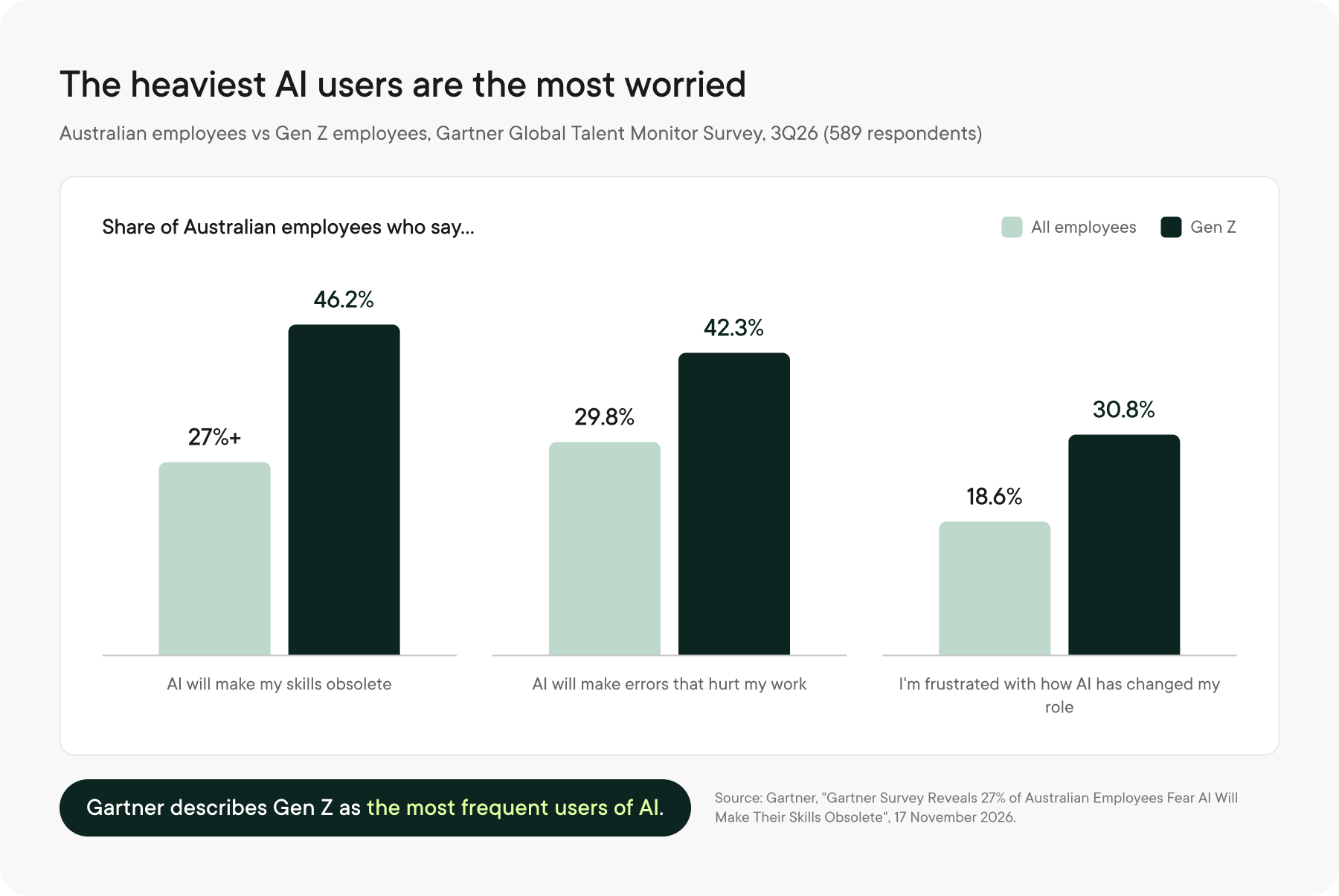
Gartner identifies Gen Z as the most frequent users of AI. The cohort relying on these tools most heavily is also the most uneasy about what that reliance is doing to their underlying capability. On a standard adoption dashboard, that same group looks like your biggest success.
Picture a claims team drafting every customer letter with an AI assistant. Usage climbs month on month, turnaround times drop, and complaint rates stay flat. Every operational metric says the rollout worked, yet none of those numbers tell you whether anyone on that team could still write a complex letter if the tool went down tomorrow.
Skill decay from AI happens quietly. Usage figures rise at the exact same time unassisted capability falls, meaning a healthy adoption chart can mask a weakening team. Output quality stays high because the software carries the cognitive load. Meanwhile, static skills profiles only record what someone could do during their last assessment, which often predates the rollout, and annual performance reviews filter everything through a single manager's perspective.
Usually, the employee notices AI deskilling first, reaching for a task they once handled automatically and realising they struggle to start without a prompt. Hiring teams already recognise a version of this risk as skillfishing, where candidates use AI to polish skills that fail to hold up on the job. Inside an existing workforce, that same gap widens undetected because nobody is testing for it.
Jonathan Tabah, Director Analyst in the Gartner HR practice, frames the challenge as an active choice: organisations must "intentionally decide which skills can be allowed to atrophy". Gartner outlines three steps for HR leaders:
Both step one and step two rely on visibility HR rarely has: knowing which tasks have shifted to AI, in which teams, and to what extent. A position description still lists monthly reconciliations long after the finance team stopped doing them manually. Business leaders can define which skills matter commercially, while only the employees executing those tasks daily know which capabilities they have quietly stopped practising.
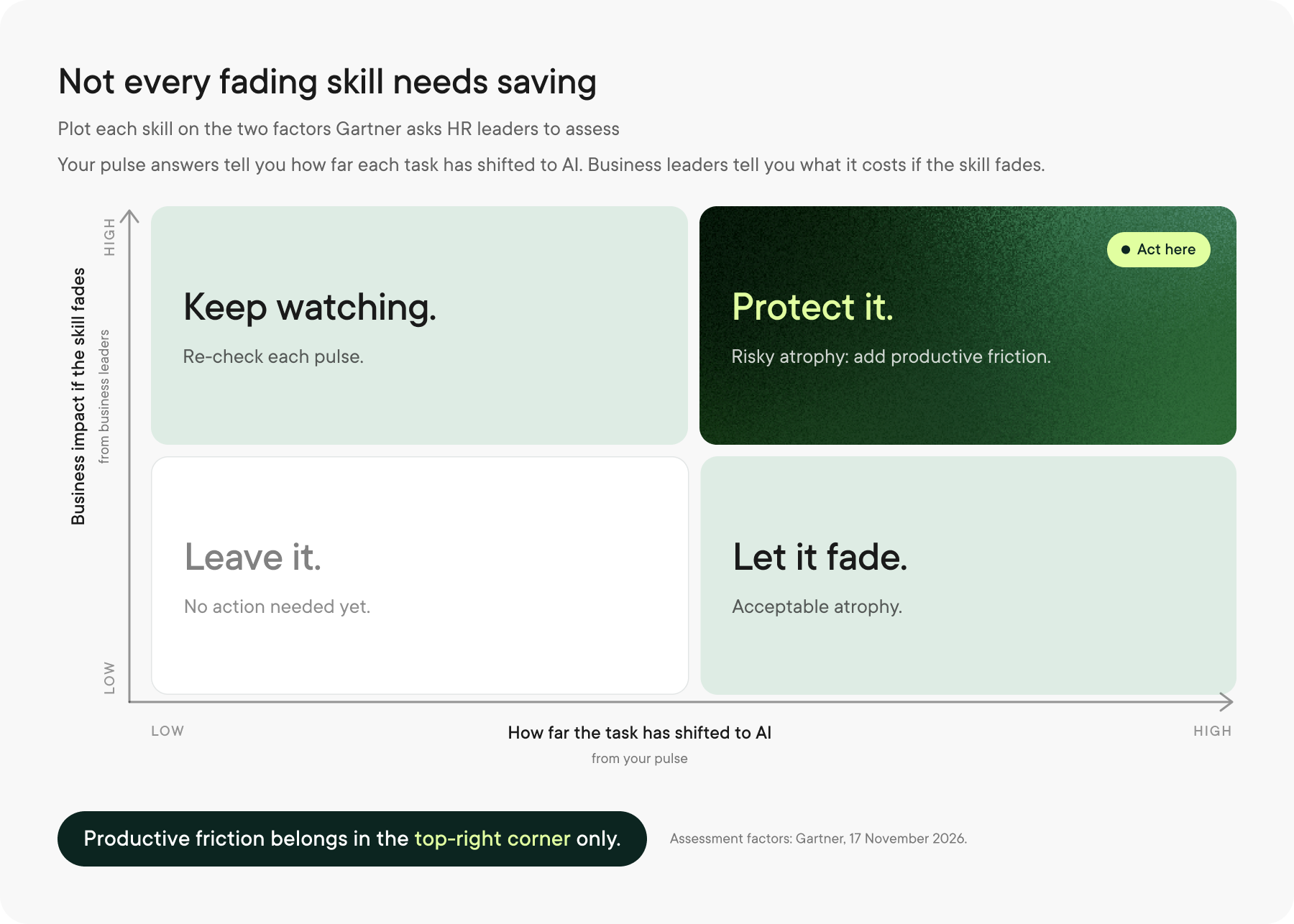
Before anyone builds a new skills taxonomy, someone has to ask the team.
You can gather this baseline without buying a new platform. Six targeted employee AI survey questions, paired with guaranteed anonymity, will reveal far more than a software usage report:
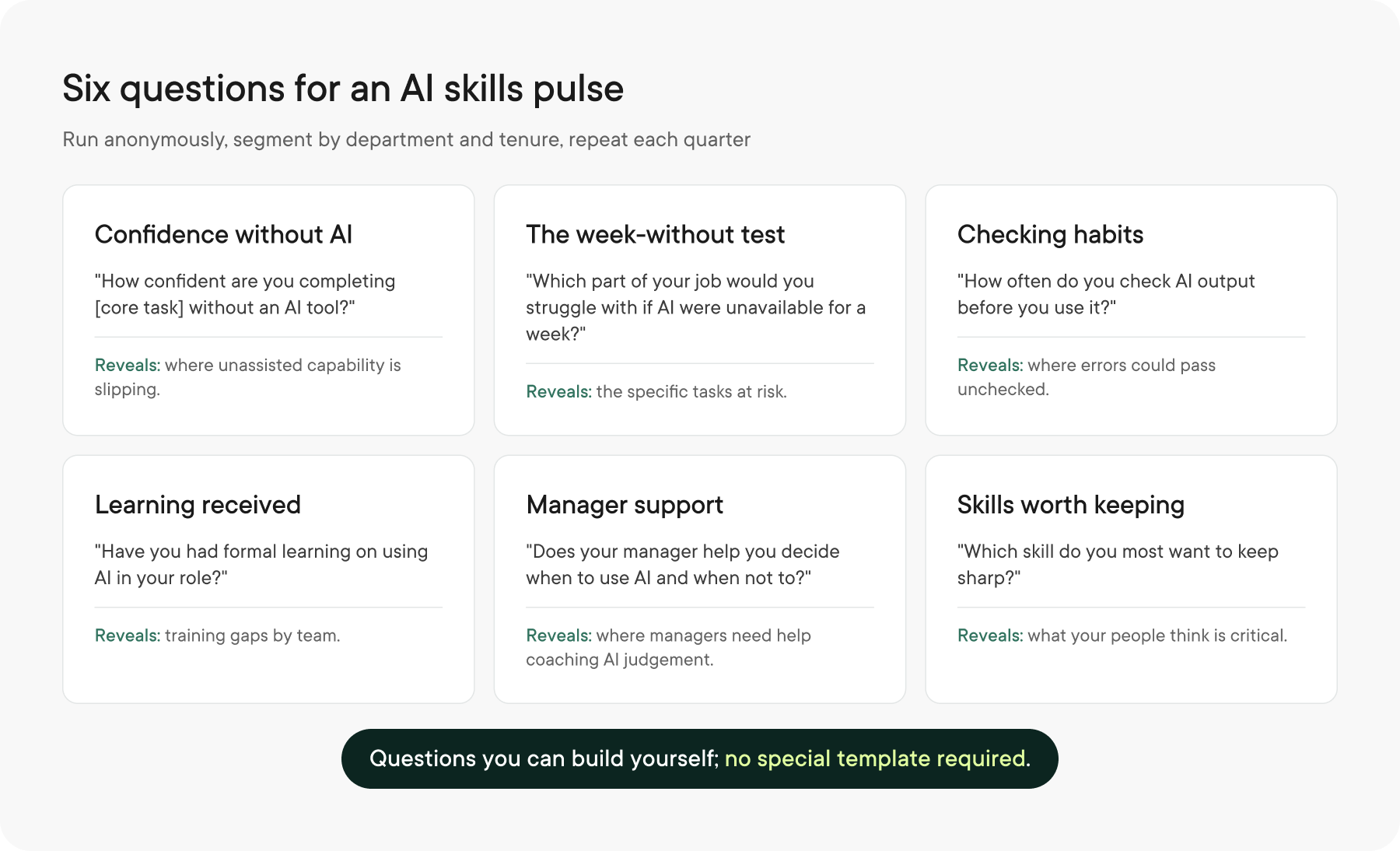
Survey administration matters just as much as question design. Anonymity is essential, otherwise staff will downplay what they can no longer do unaided. Segmenting results by department and tenure prevents a company-wide average from hiding the single function where unassisted capability has dropped furthest. Repeating the survey quarterly turns an isolated snapshot into a clear trend line, and our guide on how often to run a pulse survey breaks down the cadence trade-offs.
Xref Pulse Surveys let you build custom questions or start from HR-approved templates, protecting anonymity by only displaying insights once five or more completed responses are returned. You can filter results by department and compare data across multiple survey cycles. Built-in AI Summaries analyse ratings, overall feedback, and individual comments, making it straightforward to review open-text responses to questions two and six. Inside the Survey Builder, adding an optional comment field to any rating question ensures a low confidence score comes with clear context.
Fear of skill obsolescence drives people toward job boards just as often as training catalogues. Your heaviest AI users are currently your most anxious employees, belonging to an early-career cohort that AI has already made scarcer and costlier to lose.
Gartner lists "Continuous Transformation Erodes Employee Engagement" among four top enterprise risks for the Australian HR agenda in 2027. In the same set of Symposium releases, Gartner estimates that in a 10,000-person organisation, every 1% drop in engagement can add approximately $272,590 in annual turnover costs. While that figure is a modelled estimate best read as an order of magnitude, it attaches a clear financial cost to leaving AI anxiety unmeasured. Dion Love, VP Analyst in the Gartner HR practice, argues that responsibility for employee commitment must be shared across the entire leadership team.
Employees need clear guidance on when to lean on AI and when to work manually, yet Gartner's data shows many are left guessing: only 60.9% report receiving clear AI guidelines, and 56.9% report manager support. Most managers are being asked to coach AI judgement they were never formally trained in themselves. Question five in your pulse gives you a team-by-team view of where that support is landing, while a Leadership 360° survey gathers feedback from peers and direct reports on how individual leaders are guiding their teams through change.
Start with a focused diagnostic before committing budget to a broader training programme:
Your initial rollout checklist covered software licences and acceptable-use policies. Adding one more step, regularly asking your people what they could no longer do without AI, keeps your workforce capability visible as tools evolve. Explore Xref Pulse Surveys to build your first AI skills pulse.
Uncover data-driven, actionable insights with automated reference, pulse and exit surveys.